How to Build a Senior Living Marketing Plan in Canada


Share the page:
TL;DR
A senior living marketing plan should start from the number of move-ins a residence needs, not from a list of channels. Cushman & Wakefield put Canadian seniors housing occupancy at 93% at year-end 2025, so a building well below that has to find out why before it buys more advertising, and CMHC's seniors' housing survey, the last public local benchmark, stopped after 2021. This guide is for marketing and sales directors at Canadian retirement residences. It covers the occupancy math, the channel mix and budget, the Canadian rules that shape each channel, and what to report each month.
Introduction: A marketing plan starts with a move-in number
Many of the marketing plans that reach our desks at Senior Maple Marketing open the same way: a list of channels and a budget split. Google Ads, Facebook, a monthly newsletter, an open house in the spring. What the first page rarely shows is how many move-ins the residence needs this year, and how many tours and inquiries that will take.
Without that number, every channel looks essential or wasteful depending on who presents it. And low occupancy is often not a lead problem. Pricing, staffing, the state of the building and the local market can each hold a residence back, and more advertising fixes none of them.
This guide builds the plan in the order we build it with operators: the target, the inquiry path, the channels and budget, the rules, then the reporting.
What should a senior living marketing plan include?
Five parts, built in order: a move-in target, an inquiry path that can handle it, a channel mix and budget, a compliance check for each channel, and a reporting calendar. Each part depends on the one before it. A channel budget is only defensible once the move-in target exists, and the reporting only works if the CRM records where every inquiry came from.
Keep the plan short enough to use. Two pages that the executive director and the sales team read every month will do more than a forty-page deck nobody opens after the budget meeting. Page one holds the target and the monthly numbers that lead to it. Page two holds the channels, the budget, the checks and the review dates.
The graphic below shows the five steps in order.
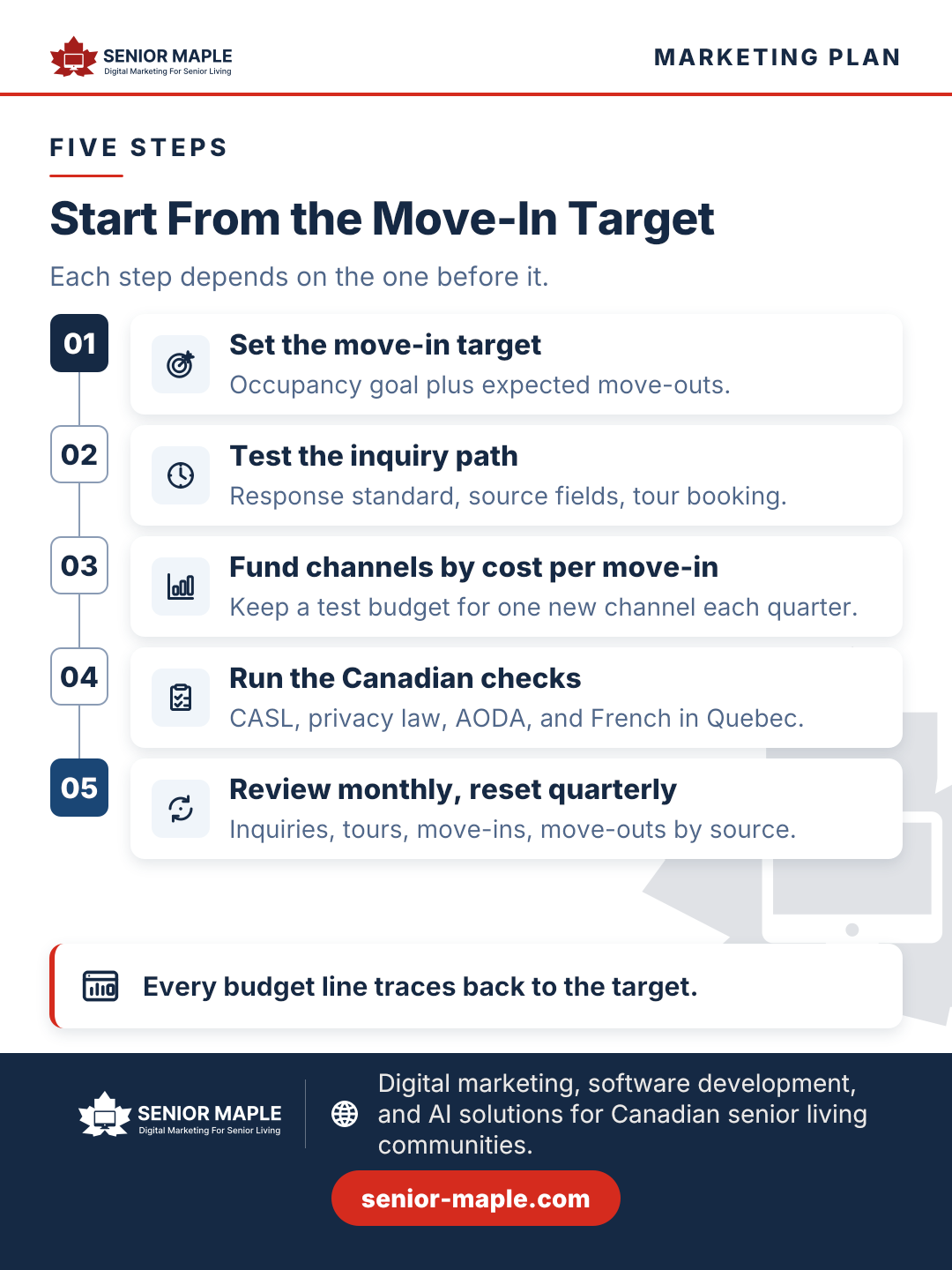
Key Takeaway: Put the move-in target on page one of the plan, and make every budget line trace back to it.
How many move-ins does the plan need to deliver?
Work backwards from occupancy. Take the occupancy you want in 12 months, add the move-outs you expect over the same period, then divide by your own conversion rates to find the tours and inquiries you need each month.
Move-outs are the line most plans leave out. Some residents move to a long-term care home or closer to family, and some reach the end of their lives. Each departure has to be replaced before occupancy can grow. Your CRM or property management system holds last year's count; adjust it for what you already know, such as residents on the waiting list for long-term care.
The table shows the arithmetic for an illustrative 120-suite residence. Replace every rate with your own figures for the last 12 months.
| Step | How to calculate it | Illustrative example |
|---|---|---|
| Current occupancy | Occupied suites divided by total suites | 105 of 120 suites (87.5%) |
| Target in 12 months | The occupancy the budget is meant to buy | 94%, or 113 occupied suites |
| Net gain needed | Target suites minus occupied suites | 8 suites |
| Expected move-outs | Last year's count from the CRM, adjusted for what you know | 28 |
| Move-ins needed | Net gain plus expected move-outs | 36 a year, or 3 a month |
| Tours needed | Move-ins divided by your tour-to-move-in rate | At 25%: 144 a year, or 12 a month |
| Inquiries needed | Tours divided by your inquiry-to-tour rate | At 40%: 360 a year, or 30 a month |
The rates are placeholders for the arithmetic, not benchmarks. Use your own trailing 12 months.
National figures won't set this target for you. Statistics Canada estimates that 20.0% of Canada's population was aged 65 and older on July 1, 2026, but that growth doesn't decide whether a particular residence fills. There's no current public series for a local market either: CMHC stopped collecting rents, vacancies and services for its Seniors' Housing Survey after 2021, and the Canadian Senior Living Association is asking for the survey to be reinstated. The benchmark you can trust is your own history.
Key Takeaway: Move-ins needed equal the net occupancy gain plus expected move-outs. Convert them into monthly tours and inquiries with your own rates.
Which channels belong in the plan, and how much should each get?
Fund first the channels that already produce move-ins at a cost you can accept, and give new channels a small, time-limited test. That depends on knowing cost per move-in by source: what a channel cost over 12 months, divided by the move-ins it produced.
Most Canadian residences draw on the same core set:
- Search and AI answers. Families search by their province's care names: retirement home in Ontario, assisted living residence in British Columbia, supportive living in Alberta, RPA in Quebec. Care-level pages written in those terms, a complete Google Business Profile and plain answers that AI tools can cite are the base of SEO and AI search optimization.
- Paid search. Google Ads reaches families who are ready to call. Send each ad to the page for the care level it mentions, never the home page.
- Referrals. Local professionals, residents' families, and referral services and aggregators such as A Place for Mom. Treat each as a source with its own cost per move-in, commissions included.
- Nurture. Most inquiries aren't ready to move this month. An email nurture program keeps the residence in front of them until they are, within the consent rules in the next section.
- Visits. Open houses, lunch visits and respite stays offered as trial stays turn interest into a tour.
Before adding any channel, test the inquiry path. If a web inquiry waits until the next business day for a reply, more traffic only produces more unanswered inquiries. Set a response standard for office hours and after hours, name who owns each, and check it monthly.
If you can't say which channels produced last year's move-ins, a digital audit will show where inquiries come from and where they're lost.
Key Takeaway: Rank channels by cost per move-in, fund them in that order, and hold back a small test budget for one new channel each quarter.
Which Canadian rules shape a senior living marketing plan?
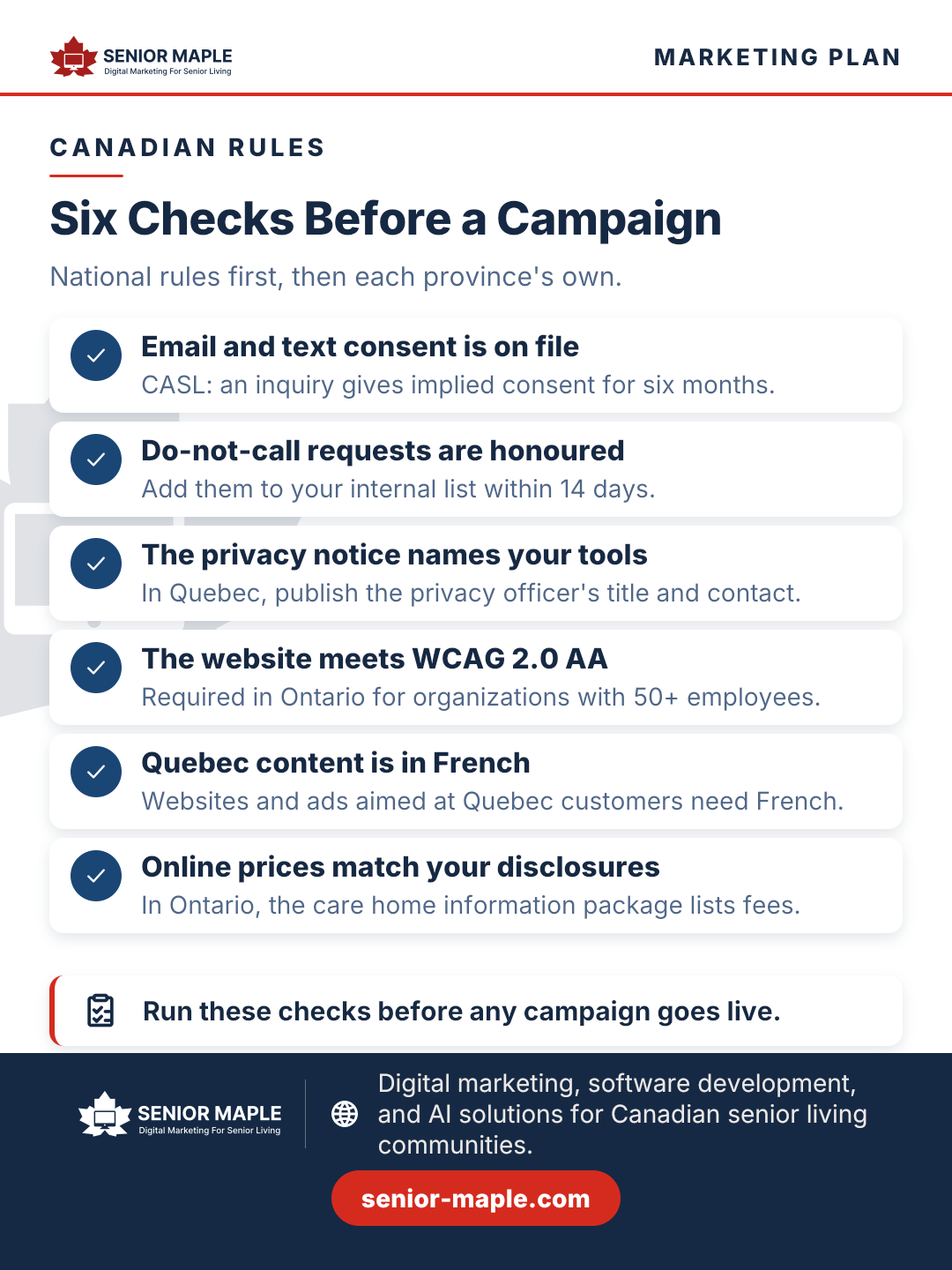
National rules apply everywhere, and several provinces add their own. Run these checks before a campaign launches, and have counsel confirm how each applies to your residences.
- Email and text messages. Under Canada's Anti-Spam Legislation (CASL), follow-up emails and texts are commercial electronic messages. You need consent, each message identifies the sender, and each carries a working unsubscribe. An inquiry gives implied consent for six months, so ask for express consent early and record it in the CRM.
- Phone calls. Calls fall under the CRTC's telemarketing rules rather than CASL. When a family asks you to stop calling, the rules give you 14 days to add them to your internal do-not-call list.
- Privacy. Inquiry forms, call recordings and CRM notes hold personal information covered by PIPEDA or a provincial private-sector privacy law. In Quebec, the title and contact information of the person in charge of protecting personal information must be published on the business's website.
- Accessibility. In Ontario, organizations with 50 or more employees must make their public websites meet WCAG 2.0 Level AA (live captions and pre-recorded audio descriptions excepted) under the Accessibility for Ontarians with Disabilities Act (AODA). An AODA compliance review shows where a site falls short.
- French in Quebec. The Office québécois de la langue française says a business operating in Quebec must make its website available in French and publish its advertising in French. Other languages can sit alongside.
- Prices in Ontario. A care home, including a retirement home, must give a new tenant a care home information package that discloses its fees and services before the tenancy agreement is signed. Prices on the website and in ads should match it.
The graphic below sets out the six checks for whoever signs off on campaigns.
Key Takeaway: Record email consent in the CRM, publish what Quebec and Ontario require, and confirm WCAG 2.0 AA before you pay to send traffic to the site.
How do you know whether the plan is working?
Count move-ins, not leads. A plan that doubles inquiries and adds no move-ins hasn't worked, and only the full path from inquiry to tour to move-in shows which channel did the work.
Report five numbers by source each month:
- Speed to first response: time from inquiry to a reply from a person.
- Inquiry-to-tour rate: tours divided by inquiries.
- Tour-to-move-in rate: move-ins divided by tours.
- Cost per move-in: channel spend divided by the move-ins it produced.
- Move-outs: by reason, against the forecast in the plan.
The source field is where reporting usually breaks. A pattern we see in Senior Maple Marketing's CRM integration projects: move-ins credited to "website" because that's where the family finally filled in a form, after a referral, an ad and two phone calls. Call tracking, source fields on every form and a "How did you hear about us?" question on the first call fix most of it.
Review the numbers monthly with the executive director, move budget between channels each quarter, and rebuild the plan once a year from occupancy and move-outs.
Key Takeaway: Report inquiries, tours, move-ins and move-outs by source every month, and judge each channel by its cost per move-in.
Frequently Asked Questions
How much should a senior living community spend on marketing?
There's no reliable public Canadian benchmark, and percentage-of-revenue rules from US sources don't transfer. Build the budget from the move-in target instead: multiply the move-ins you need from each source by what that source has cost per move-in over the last 12 months, then add a test budget for one new channel. If you can't calculate cost per move-in yet, fix the CRM source data first.
How often should a senior living marketing plan be updated?
Review the numbers monthly, reset the plan each quarter and rebuild it once a year. Monthly reviews catch a slow response time or a channel whose cost per move-in is climbing. The quarterly reset moves budget between channels. The annual rebuild starts again from occupancy and move-outs. Rebuild sooner after a major change, such as a new building phase or new care services.
Can we email families who inquired months ago?
Within six months of the inquiry, yes. Under CASL, an inquiry gives implied consent for six months. After that you need express consent, so ask for it in the first conversation and record it in the CRM. Every message must identify the sender and include a working unsubscribe, and unsubscribe requests must be honoured within 10 business days.
Does a retirement residence website have to meet accessibility standards?
In Ontario, yes, if the organization has 50 or more employees. The AODA's Integrated Accessibility Standards Regulation requires public websites to meet WCAG 2.0 Level AA. Rules in other provinces differ, so check them for each residence. Building to WCAG 2.1 AA covers the Ontario requirement and makes the site easier for older adults and their families to use.
Do marketing materials in Quebec have to be in French?
Yes, for content aimed at customers in Quebec. The Office québécois de la langue française says a business operating in Quebec must make its website available in French, with all content offered in French, and that its advertising, including advertising published online, must be in French. Other languages can be used as well, as long as the French version is available.
How Senior Maple Marketing approaches a senior living marketing plan
We start with data the operator already has. Twelve months of inquiries, tours, move-ins and move-outs come out of the CRM and the property management system, sorted by source, before anyone discusses channels. Where the source data is missing, fixing it is the first project, because every later decision depends on it.
Next, we set the move-in target with the executive director and test the inquiry path against it: response times, call handling, tour booking and the website forms. Only then do we choose channels and split the budget, keeping a test line for one new channel each quarter. Search, paid media, content and email sit with our Digital Marketing team; CRM connections and reporting sit with Software.
Before launch, every channel goes through the Canadian checks: CASL consent records, the privacy notice, WCAG 2.0 AA in Ontario and French content in Quebec. After launch, we report the five numbers monthly and reset the budget each quarter.
We advise against three things: budgets copied as a percentage of revenue from US benchmarks, bought email lists, and paid traffic sent to a site before the inquiry path can handle it.
Conclusion: Put the move-in number on page one
Write the move-in target first, then make every channel, budget line and report answer to it. Test the inquiry path before you add spend, run the Canadian checks before each campaign, and review the numbers every month.
If your CRM can't tell you which sources produced last year's move-ins, start there. Senior Maple Marketing's CRM integration work connects Yardi, Aline or WelcomeHome to your website forms and call tracking, so next year's plan starts from real numbers.
Sources
- Cushman & Wakefield, "Canada Seniors Housing Industry Primed for Record Year in 2026 Cushman & Wakefield Report Finds", February 5, 2026.
- Canada Mortgage and Housing Corporation, "Seniors' Housing Survey data tables" (2013 to 2021).
- Canadian Senior Living Association, "Seniors Housing Survey Campaign".
- Statistics Canada, "Canada's population estimates: Age and gender, 2026", The Daily, September 23, 2026.
- Canadian Radio-television and Telecommunications Commission, "Frequently Asked Questions about Canada's Anti-Spam Legislation".
- Canadian Radio-television and Telecommunications Commission, "Guidance on Implied Consent".
- Canadian Radio-television and Telecommunications Commission, "About registering and who can still call you".
- Act respecting the protection of personal information in the private sector, CQLR c. P-39.1, s. 3.1 (LégisQuébec).
- Government of Ontario, "How to make websites accessible", updated September 21, 2026.
- Office québécois de la langue française, "Médias sociaux, sites Web et documents publicitaires : Le saviez-vous?".
- Government of Ontario, "A guide to programs and services for seniors: Home and housing", updated August 21, 2026.
Stay Ahead - Subscribe Now!
You may also be interested