The Direct Lead Engine: Why Senior Care CRM and Automation Outperform Traditional Aggregators

Share the page:
TL;DR
Senior living lead generation in Canada runs on two kinds of inquiries: direct ones through the residence's own website, phone line and Google Business Profile, and paid referrals from services that charge a fee when a family moves in. Statistics Canada's latest internet use survey found that 82.6% of people aged 65 and older, and 94.6% of people aged 55 to 64, used the internet in 2022, so families can reach a residence without a go-between. How fast and how well the residence answers decides much of what follows. This guide shows sales and marketing directors at Canadian retirement residences how to compare lead sources by cost per move-in, and how a CRM and automation keep direct inquiries from going cold.
Introduction: A referral invoice is easier to count than a lost inquiry
Sorting a residence's move-ins by source takes up a good part of our week at Senior Maple Marketing, and the paid referral column is usually the quickest to fill in. Each referred move-in arrives with an invoice. The direct column takes detective work: a web form logged as "website", a call nobody tagged, a click from the Google Business Profile that turned into a tour three weeks later.
That imbalance shapes budgets. A referral fee is exact and visible. A web inquiry that waited until morning for a reply shows up on no report, so a residence can keep paying for new leads while the ones it has go cold.
The sections below compare the two kinds of lead and show how to measure both.
Where do direct leads come from in senior living?
Direct leads come from the residence's own channels and relationships: its website and inquiry forms, its phone line, its Google Business Profile, paid search, events and visits, and the professionals and families who already know it. No referral service sits between the family and the sales team, so the residence runs the first conversation.
Each channel produces inquiries when it answers the question a family is asking at that moment:
- Search and the website. Families search by place and by their province's care name: a retirement home in Ontario, an assisted living residence in British Columbia, supportive living in Alberta, a private seniors' residence (RPA) in Quebec. Care-level pages in those terms, with a price range and a short form, are the core of SEO and AI search optimization.
- Google Business Profile. The right primary category, current hours and photos, answered reviews and a phone number that a person picks up.
- Paid search. Google Ads on care-level and place terms, with each ad sent to the page that matches it.
- Professional referral sources. Physicians, home care staff, hospital social workers, lawyers and financial planners. They're unpaid, and they keep referring to residences that answer quickly and say plainly what they can and can't do.
- Families and events. Residents' families, lunch visits, open houses and respite stays offered as trial stays.
These channels serve private-pay retirement living. In Ontario, all applications and admissions to long-term care homes are arranged by Ontario Health atHome, so neither advertising nor a referral service decides who moves into a long-term care home.
Key Takeaway: List every direct source by name in the CRM, from the website form to the social worker who calls twice a year, before you judge any of them.
How do referral-service leads compare with direct leads?
They differ in who the family contacted first, who else is talking to the family, how the cost arrives and who can follow up by email afterwards. Referral services, which insiders call aggregators when they're national websites, sit between the family and the residence. A Place for Mom says its guidance is free to families, that families receive a list of senior living options, and that it's paid by participating communities if a family member moves in. In Quebec, Bonjour Résidences says its costs are covered by its network of private seniors' residences. Local senior living advisors vary, so ask each one how it's paid and whether it tells families.
The table sets the two sources side by side.
| Direct inquiry | Referral-service lead | |
|---|---|---|
| Who the family contacted | Your residence, by form, phone or visit | The referral service, which passes the family to you |
| Who else is in the conversation | Any other residence the family contacts on its own | The other residences on the family's list of options |
| How the cost arrives | Media, website and staff time, shared across every inquiry | A fee per move-in, set by the service's contract |
| Email and text follow-up | The inquiry to you gives implied consent for six months under CASL | The inquiry went to the service, so confirm consent before you email |
| What to report | Inquiries, tours, move-ins and cost per move-in, by named source | The same, with the fee and any move-in incentive included |
Contract terms differ by service. Read yours for the fee, what counts as a referral and how long a referral stays credited to the service.
None of this makes referral services bad partners. It means referred and direct move-ins are different purchases that belong on different lines of the report. A family hearing from several residences in one week compares the answers, and the residence that explains care and prices plainly on the first call starts ahead. Families read the sales process as a sample of the care.
Key Takeaway: Report referred and direct move-ins separately, and include the referral fee and any move-in incentive in the cost per move-in for that source.
When do direct leads outperform referral-service leads?
When the residence answers fast, follows up on schedule and knows what each source costs per move-in. A CRM and automation don't create inquiries; they stop the ones you have from going cold.
Start with speed to first response, and say what you measure: an automated reply confirms that an inquiry arrived, while a reply from a person answers it. Set a written standard the team can meet, such as a person calling back within one business hour, and after hours an automated acknowledgment followed by a call before 10 a.m.
Then let the CRM do the routing. Every new inquiry should land in Yardi, Aline, WelcomeHome or whichever CRM you use with its source, an owner and a task due. An inquiry retyped from an email loses its source and timestamp, the two things you need to measure response; CRM integration sends web forms straight in with both attached.
Duplicates come next. One of the first things a CRM review at Senior Maple Marketing turns up is the same family entered twice: once from the website form and once from a referral email, with the move-in credited to whichever record the sales counsellor happened to open. Check your referral agreement's definition of a referral, then decide in the CRM which record keeps the source.
Automation covers the steps people forget. Workflow automation can send the acknowledgment, create the task, alert the owner and flag a follow-up that's due. Email to families who aren't ready to tour can run on a schedule too, within the consent each family has given.
The graphic below sets four habits that cost direct inquiries against what to do instead.
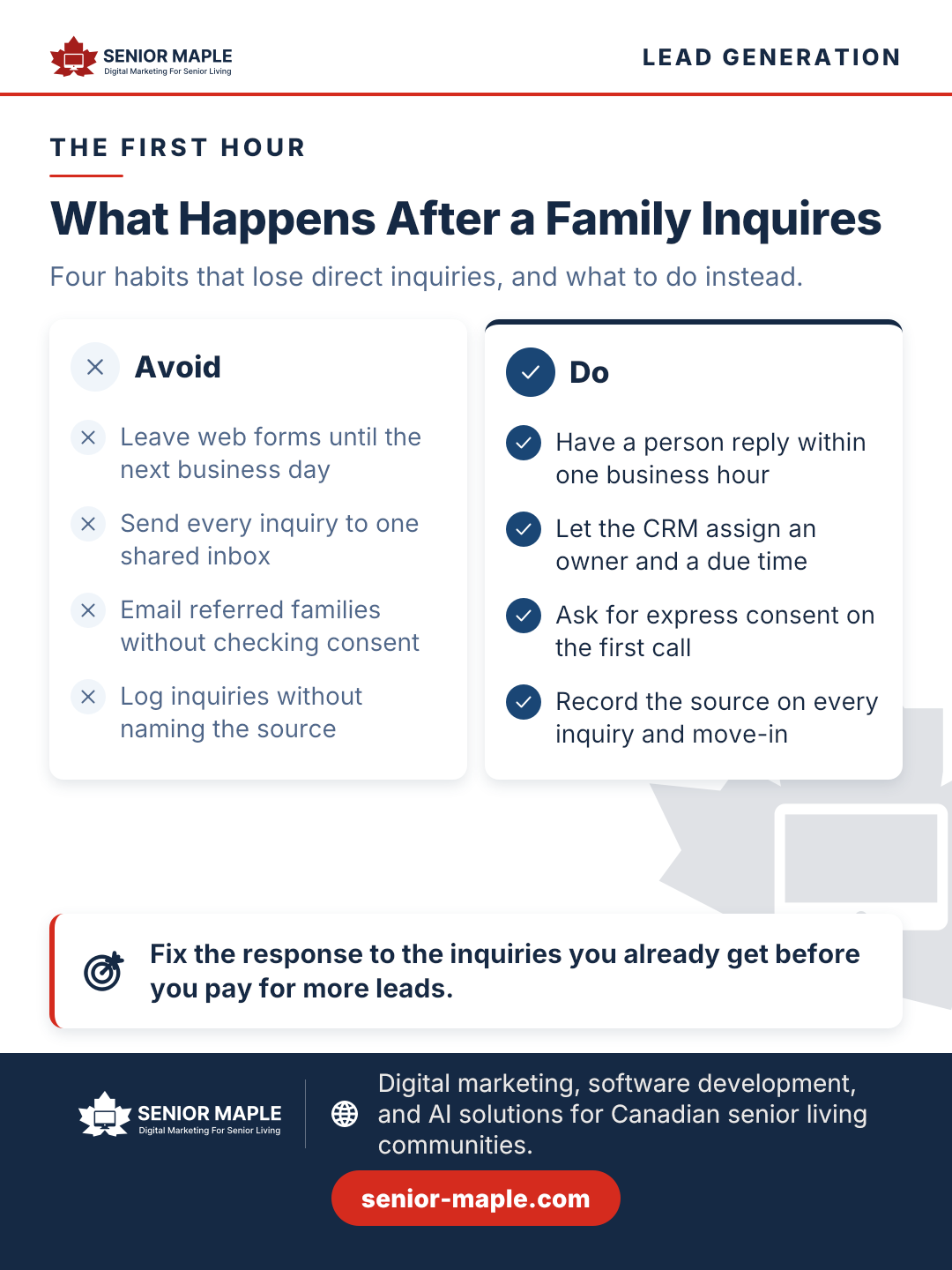
Key Takeaway: Write down a response standard, such as a reply from a person within one business hour, and have the CRM give every new inquiry an owner and a due time.
How should you measure senior living lead generation by source?
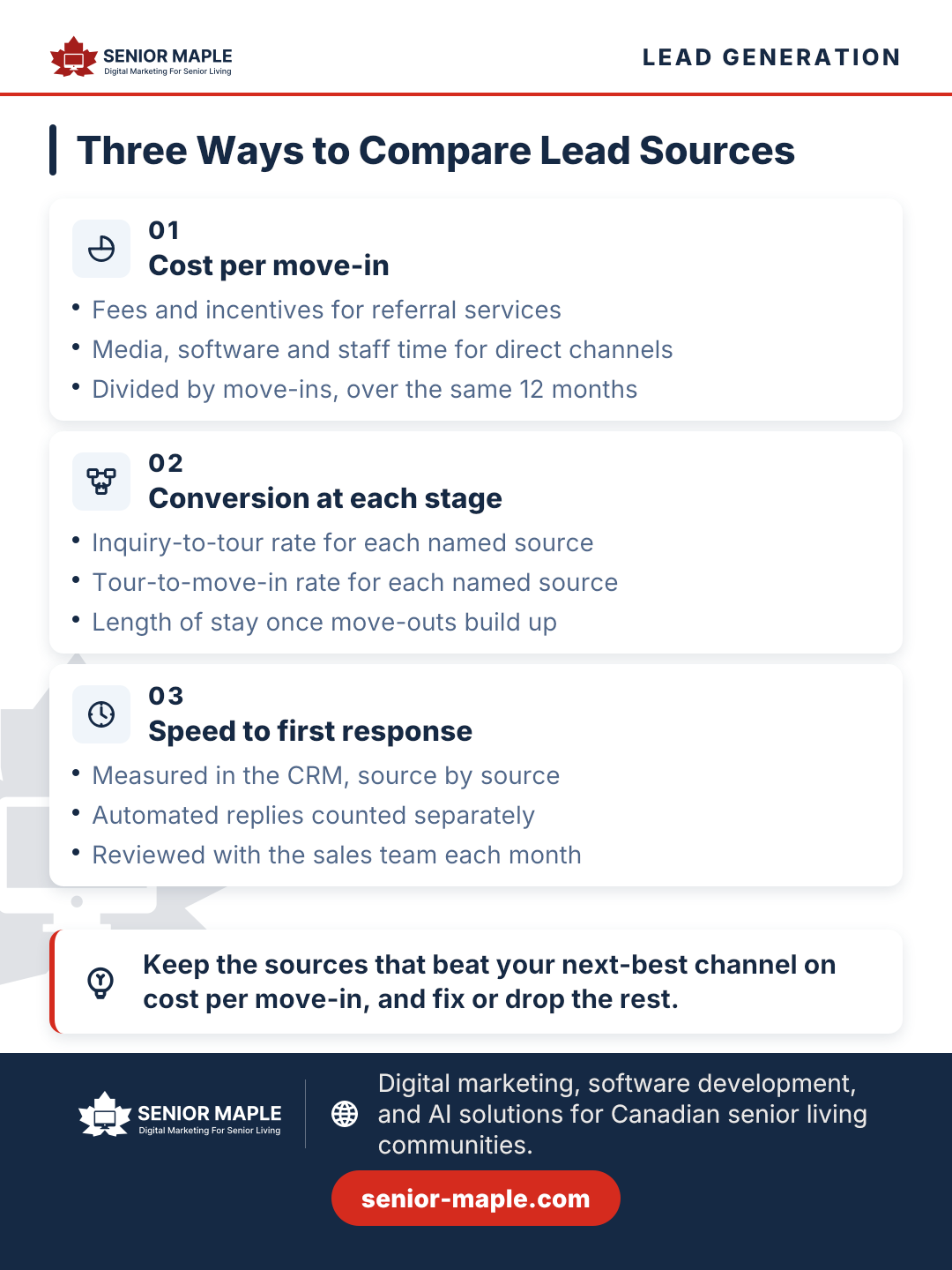
By cost per move-in and by conversion at each stage, for each named source, over the same 12 months. Lead counts on their own reward volume, and a source that sends many inquiries and few move-ins can cost more per move-in than one that sends a handful.
Cost per move-in for a source is what you spent on it divided by the move-ins it produced. For a referral service, count the fees plus any move-in incentive. For a direct channel, count the media spend, the agency or software costs tied to it and, where you can estimate it, staff time.
Then track three more numbers:
- Speed to first response by source, with automated replies and replies from a person counted separately.
- Inquiry-to-tour and tour-to-move-in rates by source. A source with a low inquiry-to-tour rate may be sending families the residence can't serve.
- Length of stay by source, once you have a year or two of move-outs. It shows whether a lower-cost source brings residents who stay.
The graphic below sets out the three comparisons.
Our guide to building a senior living marketing plan shows how to turn a move-in target into the monthly inquiries and tours these numbers are measured against.
Key Takeaway: Compare every source on cost per move-in over the same 12 months, with fees, incentives and staff time included, before you renew or cancel a lead contract.
When does a referral service still earn its fee?
When it brings families you can't yet reach on your own, at a cost per move-in you'd accept from any other channel. Treat a referral service as one more channel to measure.
That's often the case in four situations:
- A new building in lease-up, before it has search history, reviews or a name in the neighbourhood.
- Long-distance families, such as an adult child in another province, who may start with a national service.
- A care level with few local options, where a family needs help finding any vacancy.
- A short-notice move, such as one after a hospital discharge, when the family wants the list narrowed for them.
It stops earning its fee when the families it sends would have found you anyway, or when its cost per move-in sits above your direct channels'. Before each renewal, reread the agreement's definition of a referral, and ask the service how it tells families who pays it.
Key Takeaway: Keep a referral service where its cost per move-in beats your next-best channel, and review its referral definition before every renewal.
Frequently Asked Questions
How do senior living communities generate leads?
Through their own channels and through people who know them. Direct leads come from the website, the phone line, the Google Business Profile, paid search and events. Referrals come from residents' families, professionals such as physicians and home care staff, and paid referral services. Track every source by name in the CRM, and judge each one by the move-ins it produces and what they cost.
How do referral services like A Place for Mom get paid?
By the residences. A Place for Mom says its guidance is free to families and that it's paid by participating communities if a family member moves in. In Quebec, Bonjour Résidences says its costs are covered by its network of private seniors' residences. Each service's contract sets the fee and what counts as a referral, so read it before you sign or renew.
Are referral-service leads worth the fee?
Sometimes. Compare each service's cost per move-in, with the fee and any move-in incentive included, against what your direct channels cost per move-in over the same 12 months. A service that brings families you can't reach yourself, such as long-distance families or residents for a building in lease-up, can earn its fee. One that sends families who would have found you anyway usually doesn't.
How fast should a retirement residence respond to a new inquiry?
Set a standard your team can meet, then measure it. A practical starting point is a reply from a person within one business hour, with an automated acknowledgment for inquiries that arrive after hours and a call early the next morning. Measure speed to first response from the CRM each month, by source, and report automated replies and replies from a person separately.
Can we email a family that came through a referral service?
Check consent first. Under Canada's Anti-Spam Legislation, implied consent from an inquiry covers an inquiry the family made to your business in the six months before the message, and an inquiry to a referral service was made to the service, not to you. Ask the service how it obtained consent, ask the family for express consent on your first call, and record it in the CRM. Have counsel confirm your approach.
How Senior Maple Marketing approaches senior living lead generation
We start from last year's move-ins. Each one is traced to its first inquiry and sorted by named source, with fees, incentives and media spend attached, so every source has a cost per move-in. Where the CRM can't show the source, fixing that comes first.
Next, we test the inquiry path the way a family meets it: a web form at 9 p.m., a call over lunch, a click from the Google Business Profile. Then we set the response standard with the sales team and build the routing. Software connects the CRM to the forms and call tracking, AI Solutions builds the acknowledgments and follow-up automation, and Digital Marketing runs the search, website and paid media that bring direct inquiries in.
After launch, we report inquiries, tours, move-ins and cost per move-in by source each month, and we review referral agreements against those numbers before they renew.
We advise against three things: cancelling a referral service before the response process works, buying lead lists, and automated messages that do a job a person should do.
Conclusion: Answer the leads you have before you buy more
Before you renew a referral agreement or raise the paid search budget, check what happens to the inquiries you already get: how fast a person replies, who owns each one and how many become tours. Then compare every source on cost per move-in.
If inquiries still wait in a shared inbox until someone has time, fix that first. Senior Maple Marketing sets up workflow automation that routes each inquiry to a named owner as it arrives. Bring us last month's inquiries, and we'll show you where the hours went between form and first call.
Sources
- Statistics Canada, "Who are the users of digital government services? Exploring the characteristics of Canadian individuals and businesses using digital government services", Digital Insights, April 8, 2026
- Government of Ontario, "Apply for long-term care", updated May 5, 2026.
- A Place for Mom, "How Our Service Works".
- Bonjour Résidences, "10 Things to Know About the Bonjour Résidences Platform", updated July 9, 2025.
- Canada's Anti-Spam Legislation, S.C. 2010, c. 23, subsection 10(10), paragraph (e) (Justice Laws Website, consolidation current to October 19, 2026).
Stay Ahead - Subscribe Now!
You may also be interested