Aging in Place in Canada: Why Home Is Your Real Competitor

Share the page:
Aging in place is the choice most of your prospects are making, and Canadian data shows how wide the gap is. CMHC's 2021 Seniors' Housing Survey put Ontario's capture rate, residents of seniors' residences as a share of people aged 75 and older, at 5.0 per cent; Quebec's, the highest, was 17 per cent. Your real competitor is the family home, not the residence down the road, so the case you make has to answer the house: an honest comparison of total cost and daily life, language that respects independence, and a way to stay in touch until the timing is right. This guide is for marketing and sales directors at Canadian retirement residences.
Introduction: The house doesn't need a sales team
When Senior Maple Marketing reads the lost reasons in an operator's CRM, the one that shows up more often than any competitor's name is some version of "not ready yet." The family toured, liked the dining room, and went home to the house they've lived in for forty years.
Older Canadians have said as much. In a 2020 National Institute on Ageing and TELUS Health survey, almost 100 per cent of Canadians aged 65 and older said they plan to live independently in their own homes for as long as possible. Arguing with that preference loses. This guide covers how to help a family see the whole picture, at their own pace.
How big is the gap between staying home and moving?
Wide, even on dated numbers. CMHC's capture rate divides the residents of seniors' residences by the estimated population aged 75 and older. Its 2021 Seniors' Housing Survey, collected in April and May that year, put Ontario at 5.0 per cent, down from 5.5 per cent in 2020. Quebec was highest at 17 per cent, and the other provinces fell between 5.0 and 10 per cent. CMHC has since stopped collecting rent, vacancy and service data for the survey, so treat these as 2021 figures, gathered during the pandemic.
The census shows the same picture from the other end. In 2021, close to 3 in 10 people aged 85 and older (28 per cent) lived in collective dwellings such as long-term care homes and seniors' residences, according to Statistics Canada. The rest lived in private households.
For marketing, that changes the job: growth comes mainly from people who would otherwise stay home. If your CRM's lost reasons list only competitors and price, the real competitor never shows up in a report. Adding the reason is a small change in the CRM, or a CRM integration job if the field doesn't reach your dashboards. Our guide to senior living occupancy covers the conversion rates to read alongside it.
Key Takeaway: Add "chose to stay home" as a lost reason in your CRM this month, and report it next to losses to competitors so the real competitor shows up in your numbers.
What does staying home cost a family?
More than a paid-off house suggests, once you count everything on both sides. The Government of Canada's guide to aging in place asks people to plan for home maintenance and changes such as handrails or ramps, for getting around once they stop driving, for health supports that range from out-of-pocket services to subsidized care, and for staying connected. Each of those has a cost, in money or in a family member's time.
Adapting a house is one example: the federal Home Accessibility Tax Credit applies to up to $20,000 a year of eligible renovation costs, which hints at what accessibility work can run to. Care is another. In Ontario, publicly funded home care comes through Ontario Health atHome after a care coordinator's assessment, and the province notes that people can also pay private companies for their own care. Any hours beyond what's funded come from a private agency or from family.
The life side counts too. Almost one in five people aged 65 and older (19 per cent) reported loneliness in 2019 and 2020, according to Statistics Canada. A residence shouldn't sell against loneliness with fear, but a comparison that leaves out company, shared meals and someone nearby at night isn't honest either.
Build this comparison as a worksheet, not a calculator. List every cost on both sides, let the family enter their own figures, and put your published starting price on your side of the page; our guide to senior living pricing covers what that price should include. Never fill in the family's side with averages you can't source. A worksheet that respects their numbers is the kind of content marketing a family keeps and shares with siblings.
Key Takeaway: Publish a stay-home comparison worksheet that lists every cost on both sides, lets the family enter their own figures and uses your published starting price.
How do you talk about moving without dismissing home?
Start with what the person loves about home, then show what continues and what gets easier after a move. Pages and tours that open with falls, risk or a list of what's going wrong lose the older adult in the first minute, and in the website copy Senior Maple Marketing rewrites for operators, the fix is usually to lead with what stays the same: their own furniture, their routines, their privacy, their car if there's parking.
Talk to the older adult, not past them. Adult children often book the tour, but it's the older adult's home and, usually, the older adult's decision, and they hear every word said over their head.
Ask about life at home before you show a single suite. The answers tell your sales team what to show, what to leave out and when to stop talking. The questions below are a place to start on the first call and the tour.
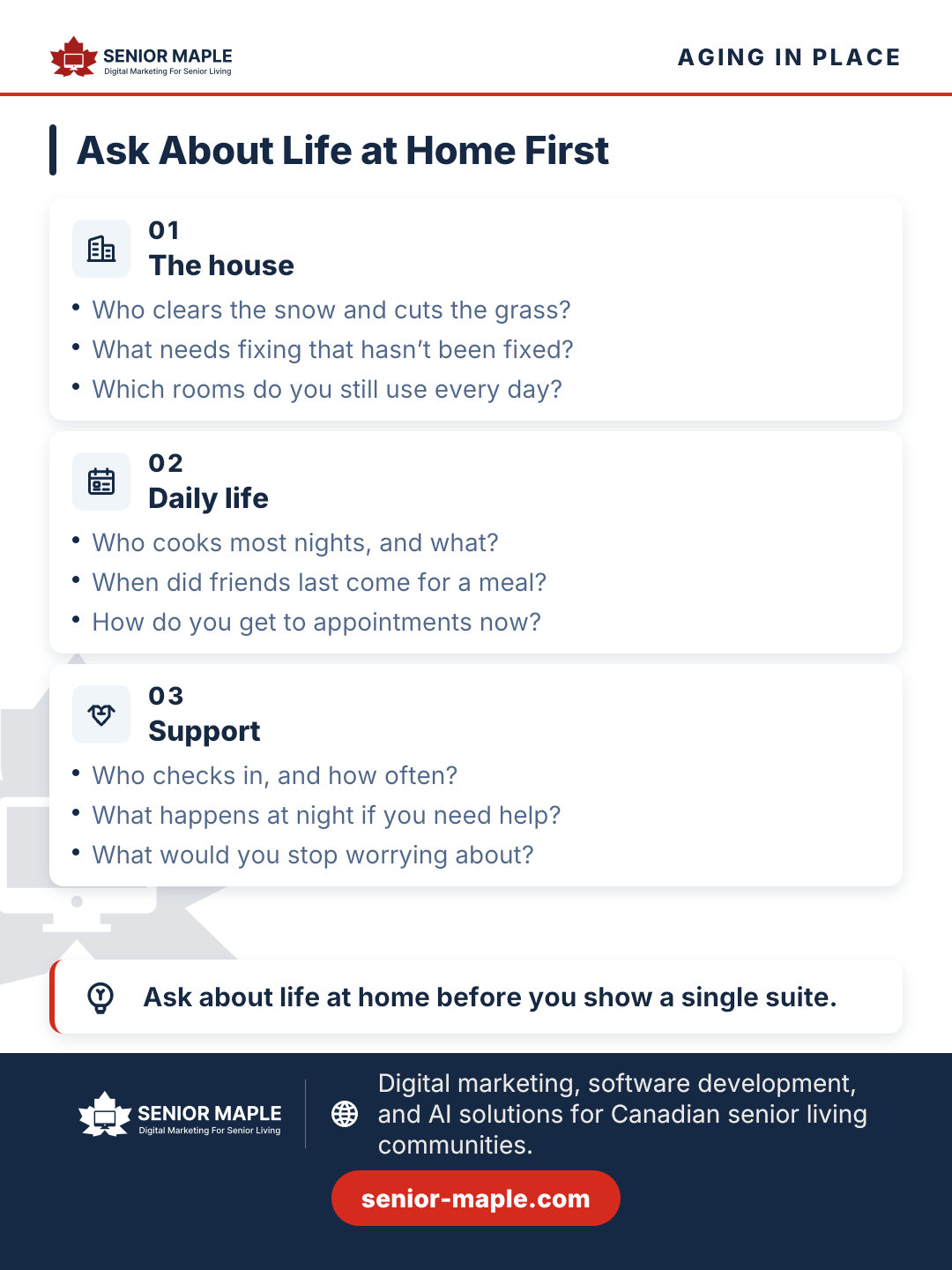
Positioning against the house is a brand strategy decision as much as a sales one: decide what your residence adds to a life the family already values, and say it the same way on the website, in ads and on the tour.
Key Takeaway: Rewrite your home page and tour script to lead with what continues after a move, and add three questions about life at home to every first call.
How do you stay in touch when the answer is "not yet"?
Give "not yet" a path: record the reason and a follow-up date, ask for consent to keep in touch, invite the family to something useful, offer a short stay where you have one, and check in each season. Services for people who aren't ready to move, such as respite stays, day programs and education events, let a family get to know the residence long before a move is urgent, so you're the first call when it is.
Email carries much of that, and it runs on consent. Under CASL, the safe habit is to ask for express consent early and record it; our guide to email marketing for senior living covers what to send and how often.
Seasons matter here. A family that said "not yet" in September may see the house differently after the first ice storm or a winter of clearing the driveway. A check-in each season, about what has changed at home rather than whether they're ready, keeps the conversation honest.
The five steps below turn "not yet" into a plan.
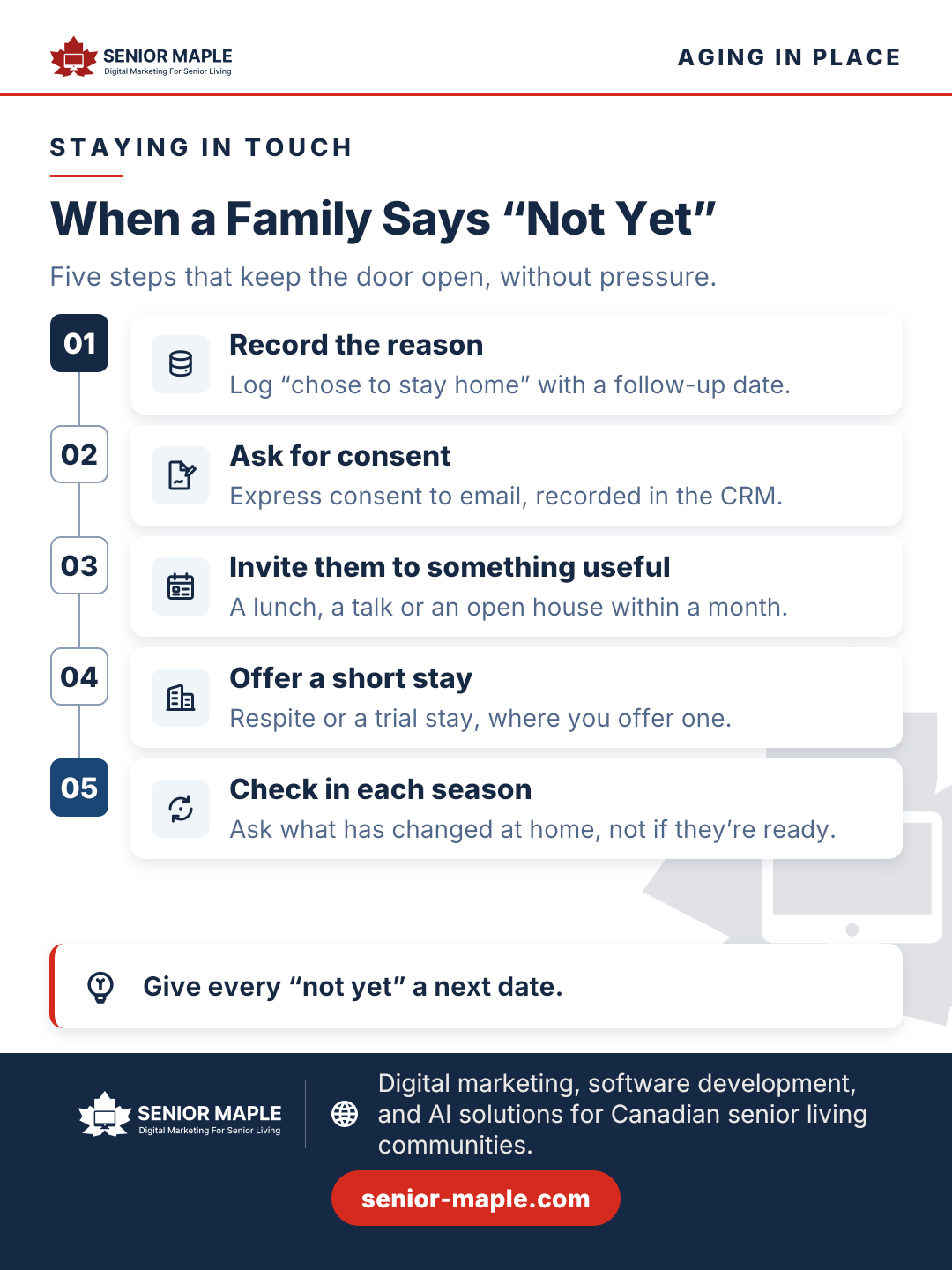
Key Takeaway: Give every "not yet" a follow-up date, an invitation within a month and a seasonal check-in, and ask for express consent before you add them to a nurture list.
Frequently Asked Questions
What does aging in place mean in Canada?
The Government of Canada defines aging in place as having the health and social supports and services you need to live safely and independently in your home or your community for as long as you wish and are able. For a retirement residence, it describes the choice most prospects make by default, which is why the family home is the main competitor.
How many older Canadians live in seniors' residences?
A small share. In CMHC's 2021 Seniors' Housing Survey, the capture rate (residents of seniors' residences measured against the population aged 75 and older) was 5.0 per cent in Ontario and 17 per cent in Quebec, with the other provinces between 5.0 and 10 per cent. In the 2021 Census, 28 per cent of people aged 85 and older lived in collective dwellings such as long-term care homes and seniors' residences.
Is staying at home cheaper than a retirement residence?
It depends on what you count. A paid-off house still carries property tax, insurance, utilities, repairs, snow removal, groceries and transportation, plus any home care beyond publicly funded hours and the time family members give. Compare those with a residence's published price and what it includes, using the family's own figures, not averages.
How do retirement residences compete with aging in place?
With an honest case that doesn't rely on fear. Track "chose to stay home" as a lost reason, publish a comparison worksheet with your starting prices, lead pages and tours with what continues after a move, ask about life at home before showing suites, and keep in touch with families who aren't ready through events, short stays and seasonal check-ins.
What should a residence do when a family says it's too soon?
Record the reason and a follow-up date, ask for consent to stay in touch, and invite the family to an event within a month. Offer a respite or trial stay if you have one, then check in each season about what has changed at home. Pressure loses families who were going to move eventually; a steady, useful presence keeps you on their list.
How Senior Maple Marketing approaches aging in place as a competitor
We start in the CRM: how many inquiries and tours ended in "not ready" or "staying home," and whether the system can record it at all. Then we read the website and the tour script the way an older adult would, looking for fear, for talk aimed past them at their children, and for missing prices.
From there, we build the honest case: a comparison worksheet that uses the family's own figures and your published starting prices, pages that lead with what continues after a move, and discovery questions for the first call. Our Digital Marketing team builds the pages, the worksheet and the nurture sequence, and our Software team connects consent and lost reasons to the CRM so the reports show them.
After launch, we report losses to home next to losses to competitors each month, with follow-ups due and event attendance, so the team can see whether "not yet" families come back.
We advise against fear-based messages about falls or decline, worksheets filled with averages nobody can source, and sales pressure on families who have said "not yet."
Conclusion: Put the house on your competitor list
This quarter, add staying home to your CRM's lost reasons, publish a stay-home comparison with your starting prices, and give every "not yet" a follow-up date and a seasonal check-in. Then rewrite one residence page and one tour script to lead with what continues after a move.
If you'd like help building the worksheet and the pages around it, Senior Maple Marketing's content marketing team can draft both with you. Send us your current tour script and a residence page, and we'll mark where they argue with the house instead of answering it.
Sources
- Canada Mortgage and Housing Corporation, Housing Observer article on the results of the 2021 Seniors' Housing Survey, July 6, 2021.
- Canada Mortgage and Housing Corporation, "Methodology for the Seniors' Housing Survey", June 27, 2022.
- Statistics Canada, "A portrait of Canada's growing population aged 85 and older from the 2021 Census", Census in Brief.
- National Institute on Ageing, "Almost 100 per cent of older Canadians surveyed plan to live independently in their own homes, but is this even possible?", September 2020.
- Government of Canada, "Thinking about aging in place", Federal, Provincial and Territorial Ministers Responsible for Seniors Forum.
- Canada Revenue Agency, "Home accessibility tax credit".
- Government of Ontario, "Home care for seniors".
- Statistics Canada, "A look at loneliness among seniors", November 6, 2023.
Stay Ahead - Subscribe Now!
You may also be interested