Senior Living Reputation Management in Canada

Share the page:
Senior living reputation management in Canada is four jobs: replying to reviews without disclosing anything about a resident, asking every family for a review in a way Google's rules allow, making your inspection record easy to find before someone else frames it, and having a crisis plan ready before an incident becomes news. Much of the record is public already. The Retirement Homes Regulatory Authority's 2023/24 annual report counts 776 licensed retirement homes in Ontario and 1,354 inspections in the year, and each home's inspection records sit in a searchable public database. This guide is for executive directors and owners of Canadian retirement residences and long-term care homes.
Introduction: Families read your record before they call you
The first thing Senior Maple Marketing checks in a reputation review is what a family sees when it searches the residence's name: the star rating, the latest reviews and whether anyone replied, the directory listings and, in Ontario, the regulator's database. Families look at all of it before they phone, usually before anyone at the residence knows they're looking.
Most of that record is produced by operations: the meals, the care, the way last spring's complaint was handled. Marketing can't rewrite it, but it decides how the residence answers it.
What does reputation management mean for a senior living operator?
It means managing what a family can read about your residence before the first call, from reviews to inspection reports to news coverage, and how quickly and plainly the residence answers it.
Start with a diagnosis. Pull your last twenty reviews, sort each complaint by department (dining, care, housekeeping, maintenance, promises made on the tour) and set the list beside the claims on your website. If the dining page promises a hot meal at every sitting and four reviews describe cold dinners, either the kitchen has a problem to fix or the page has a claim to change. What you promise is a brand strategy decision, and the safe promises are the ones the building keeps on a short-staffed Sunday.
Read the silences too. Residents can be reluctant to criticize staff they rely on every day, so a quiet review page doesn't prove satisfaction. Put your complaint log and move-out reasons beside the reviews, and when the same department shows up in all three, start there. Our guide to senior living occupancy covers how to read move-outs.
Key Takeaway: This month, sort your last twenty reviews by department, compare them with the promises on your website, and send each department head its list.
How should a residence reply to online reviews?
Briefly, from a named leader, within two business days, and without confirming anything about a resident. A reply is a public statement from the operator, and privacy law treats what it reveals as a disclosure.
A March 2025 order from British Columbia's Information and Privacy Commissioner shows the risk. A pet boarding business answered a former client's critical review by posting her name, financial details and conversations with its staff. The adjudicator found that the province's Personal Information Protection Act didn't authorize the disclosure, since refuting a review isn't a purpose the Act allows, and ordered it removed.
A residence holds far more sensitive information than a boarding business does. A reply that says "your mother's care plan was reviewed twice that week" confirms she lived there and describes her care, even if the reviewer mentioned her first. Depending on the province and the home, the law in play is PIPEDA, PIPA in British Columbia and Alberta, Quebec's private-sector act as amended by Law 25 or, for an Ontario long-term care home, PHIPA. Counsel can confirm which applies to each building.
A good reply thanks the reviewer, acknowledges the concern in general terms, says what has changed if something has, and offers a direct line to a named leader, usually the executive director. From there, the conversation moves into your complaints process. In Ontario, every licensed retirement home must have a written one under the Retirement Homes Act, 2010.
The replies Senior Maple Marketing is asked to rewrite usually fail at the same point: a care complaint, answered with details only the family should hear. Reply to good reviews too, briefly and without names; families read replies to see whether anyone is paying attention.
The graphic below sums up what to leave out of a reply and what to put in.
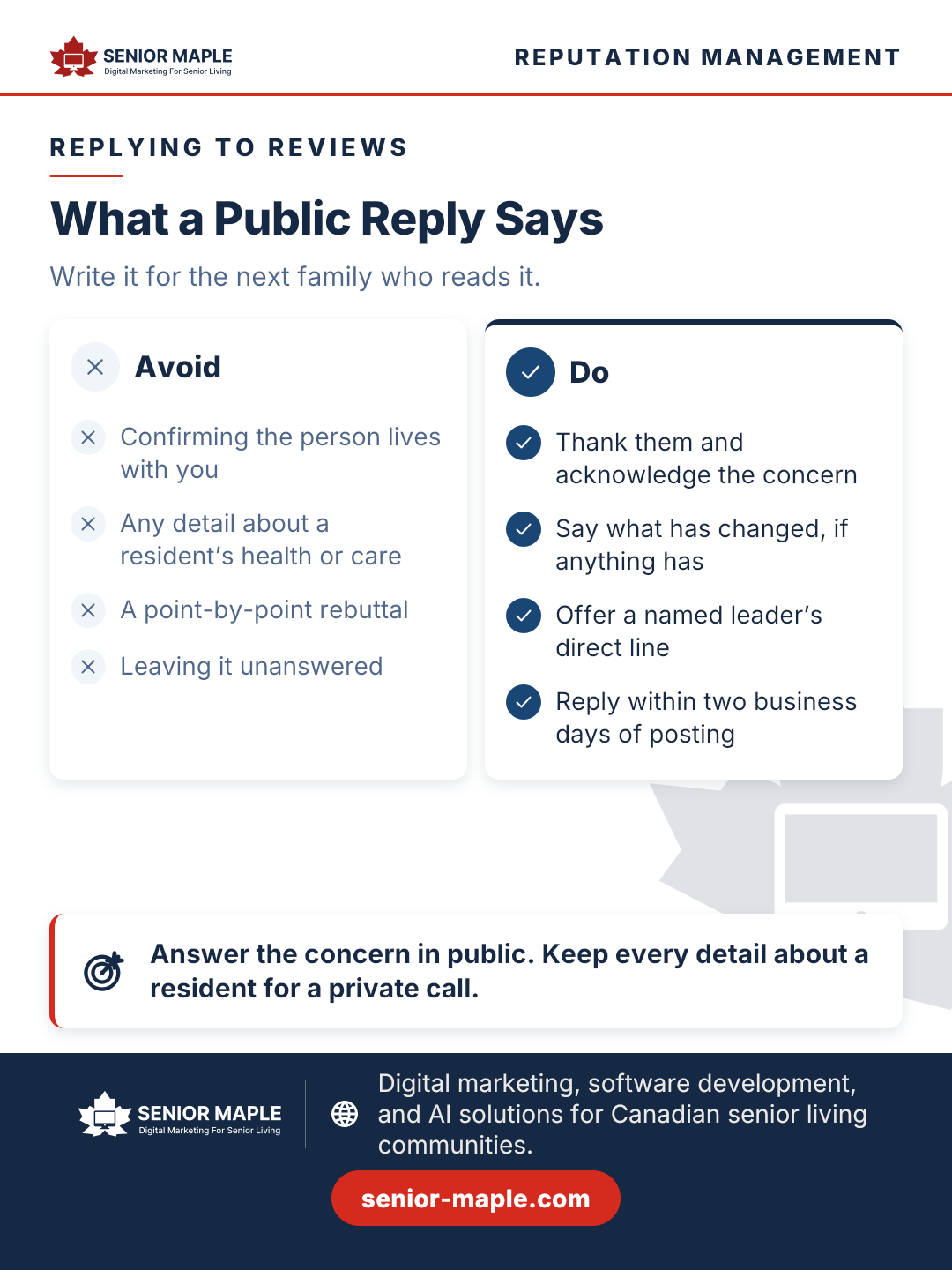
Key Takeaway: Write three approved replies (praise, a service complaint and a care complaint), have counsel review the care one, and answer every review within two business days.
How can you ask for reviews without breaking Google's rules?
Ask every resident and family at the same points in their stay, make it easy, and offer nothing in return. Google's policy for content on Maps lets businesses encourage reviews that reflect a genuine experience, and it treats these as rating manipulation:
- Offering payment, discounts, gifts or services in exchange for a review.
- Discouraging negative reviews, or asking only the families you expect to be happy.
- Requiring or pressuring people to write a review while they're on the premises.
- Asking staff to collect a set number of reviews.
The same policy prohibits reviews written with a conflict of interest, which it says can include current or former employment. The Competition Bureau adds a Canadian layer: in January 2024 it warned that businesses could be liable under the Competition Act for reviews by employees who don't disclose their connection.
In practice, put the request on a schedule rather than a mood: about two months after move-in and once a year after that, sent to every resident and family contact the same way. An email with a direct link works; a tablet at the front desk during a family visit doesn't. Build the request into your email marketing automation, and keep each residence's Google Business Profile accurate and separate so reviews land on the right building, a routine part of SEO and AI optimization. Then put the staff rules in writing: no reviews of their own residence, no asking relatives to post one, and no review targets in anyone's goals.
Key Takeaway: Send every family the same review request on a fixed schedule, with no gift attached and no tablet at the front desk, and tell staff in writing not to review their own residence.
Should you point families to your inspection record?
Yes. In Ontario, Alberta and British Columbia, much of the record is public whether you link to it or not, and a family that finds it alone also notices that you didn't mention it.
Ontario's government tells families choosing a retirement home to confirm that it's licensed and to read its recent inspection reports in the RHRA's database. That record keeps growing: the regulator's 2023/24 annual report counts 1,631 reports of harm or risk of harm, up 14 per cent on the year before.
Some of this is already in the building. A licensed retirement home in Ontario must keep inspectors' final reports from the previous two years available in the home, and a long-term care home must post its inspection reports from the past two years. Putting the same record online is a small step from there.
Add a short licensing and inspections block to each residence page: the licence or registration, a link to the regulator's record, the date of the last inspection and, where there was a finding, one plain sentence on what changed. Don't soften a finding into something milder than the report says; families can read the original. Our senior living resources list the regulators by province.
Key Takeaway: Add a licensing and inspections block to every residence page, link the regulator's record, and update the block within a week of each new report.
What belongs in a senior living crisis communications plan?
Five things, in this order: the reports the law requires; one spokesperson; a word to residents, families and staff before the public hears; a short holding statement; and updates on a schedule you keep. Write the plan now, because the first hour of an incident is no time to draft.
In Ontario, the first step isn't optional. Anyone with reasonable grounds to suspect that improper or incompetent care, abuse, neglect or unlawful conduct has harmed a resident or put them at risk of harm, or that a resident's money has been misused, must report it immediately: to the Registrar for a retirement home under the Retirement Homes Act, 2010, and to the Director for a long-term care home under the Fixing Long-Term Care Act, 2021. The report goes in before any statement goes out.
The holding statement says what happened in general terms, what you're doing about it and when you'll update next. It names no one and describes no one's health, and counsel reviews it whenever a resident is involved. Front-line staff refer media calls to the spokesperson, and residents and families hear from you before they read it anywhere else. Families who hear from the residence in ordinary months tend to give it more patience on a bad day, one more reason the family emails you send between crises matter.
The graphic below sets out the five steps.
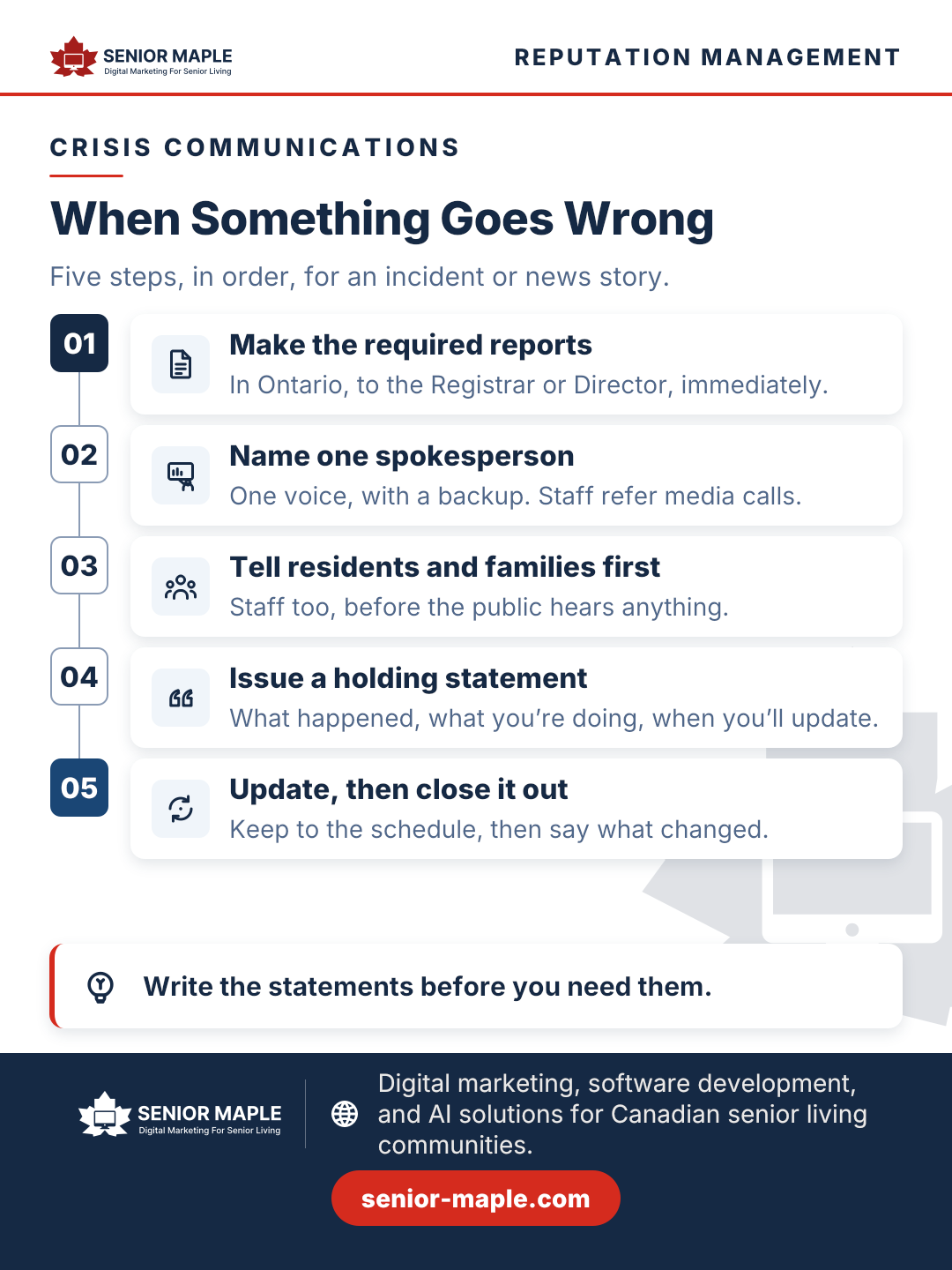
Key Takeaway: This quarter, draft holding statements for an outbreak, an incident under investigation, a media call and a critical social media post, agree who signs off on each, and rehearse the plan once a year, front desk included.
Frequently Asked Questions
What is senior living reputation management?
Managing what families can read about a residence before they call: reviews, the regulator's inspection record and news coverage. For a Canadian operator, that means replying to reviews within privacy law, asking for reviews within Google's rules, linking the public inspection record from each residence's page, and keeping a crisis plan ready.
Can a retirement home reply to a review that mentions a resident?
Yes, but without confirming that the person lives there or discussing their care, even if the reviewer did. In March 2025, British Columbia's privacy commissioner ordered a business to remove personal information it had posted in reply to a review. Thank the reviewer, acknowledge the concern, offer a named leader's direct line, and have counsel confirm which privacy law applies.
Can we ask residents and families for Google reviews?
Yes. Google lets businesses encourage reviews that reflect a genuine experience, but it treats incentives, asking only happy customers, pressure on the premises and staff review quotas as rating manipulation. Ask every resident and family the same way on a fixed schedule, and keep employees from reviewing their own residence: the Competition Bureau has warned businesses about undisclosed employee reviews.
Can a senior living operator get a negative review removed?
Only when it breaks the platform's rules. On Google, that includes fake reviews, reviews written with a conflict of interest such as current or former employment, and personal information posted without consent. You can flag those, and Google decides. A genuine negative review stays up; answer it with a short, sincere reply and a fix the next family can see.
Where can families check a retirement home's inspection record in Ontario?
In the Retirement Homes Regulatory Authority's public database, which lists each licensed home with its inspection records; the Government of Ontario's guide to choosing a retirement home sends families there. Homes must also keep inspectors' final reports from the previous two years available on site. For long-term care homes, each home's profile on ontario.ca links to its inspection reports.
How Senior Maple Marketing approaches senior living reputation management
We start with what a family can find today: a year of reviews on Google and the directory sites, sorted by department and set against the website's promises, plus each residence's record with its regulator. That separates what operations must fix from what marketing can, in one list for the executive director.
Next come the reply templates, written with your leadership team and checked by your counsel for privacy. Then we set up review requests on a fixed schedule and add a licensing and inspections block to each residence page. Our Digital Marketing team handles the profiles, the pages and the email sequence.
After launch, the executive director gets a monthly report: new reviews, reply times, complaint themes by department and anything new in the public record. Once a year, we rehearse the crisis plan with your leadership team and update the holding statements.
We advise against review incentives, asking only the families who seem happy, replies that argue with the reviewer, and any reply that says more about a resident than the reviewer did.
Conclusion: Search for your residence the way a family would
This week, search each residence by name on Google and in the regulator's database. Answer every unanswered review with an approved reply, add the inspection link to the residence page, and put the holding statements on the agenda for your next leadership meeting.
If those replies and statements don't exist yet, Senior Maple Marketing's brand strategy team can write them with you. Send us your residence names, and we'll start with what a family sees when it searches for you.
Sources
- Retirement Homes Regulatory Authority, "Annual Report 2023/24".
- Government of Ontario, "Find a retirement home".
- Government of Ontario, Retirement Homes Act, 2010, S.O. 2010, c. 11, sections 55, 73 and 75.
- Government of Ontario, Fixing Long-Term Care Act, 2021, S.O. 2021, c. 39, Sched. 1, sections 28, 85 and 180.
- Government of Alberta, "Continuing Care Inspection and Visit Results".
- Office of the Seniors Advocate British Columbia, news release on the 2025 Long-Term Care and Assisted Living Directory, January 27, 2026.
- Office of the Information and Privacy Commissioner for British Columbia, Order P25-03, March 4, 2025.
- Google, "Prohibited & restricted content", Maps user contributed content policy.
- Competition Bureau Canada, "Online reviews posted by employees: businesses could be liable", January 18, 2024.
Stay Ahead - Subscribe Now!
You may also be interested