Senior Living Keywords in Canada, Province by Province

Share the page:
Senior living keywords in Canada have to cover two vocabularies: the words families type, many of them borrowed from the US, and the names each province gives its care settings. In Ahrefs' Canadian data, "assisted living calgary" draws about 600 searches a month, while "supportive living calgary", which uses Alberta's own term, draws 40. A keyword list built from one vocabulary either misses families or misdescribes the residence. This guide shows marketing directors at Canadian retirement residences which terms families use, which names are correct in each province, and how to build pages and ad groups that serve both.
Introduction: Your keyword list may have been written for another country
Many of the keyword lists that reach Senior Maple Marketing came from a US agency or a US software template. They're full of assisted living, memory care and skilled nursing, and they miss how a daughter in Ottawa or a son in Calgary searches. Worse, they pull website copy toward names that don't match a Canadian licence.
The fix starts with two lists side by side: what families type, and what the province calls the setting. The sections below build both.
What do Canadian families type when they search for senior living?
A mix of US terms and local ones, and the mix changes by city. Near-me searches lead: in Ahrefs' Canadian database, "retirement home near me" draws about 2,400 searches a month, "long term care near me" 1,300, "assisted living near me" 900 and "nursing home near me" 700.
City searches show the gap more clearly. The table sets the term families often type beside the name that's correct in that market.
Two markets break the pattern. In British Columbia, "assisted living" is the correct name, and "assisted living vancouver" draws about 300 searches a month. In Quebec, families search the official French terms: "chsld" draws about 5,600 a month and "rpa quebec" about 500, against 90 for "assisted living montreal".
Key Takeaway: Pull Canadian volumes for both the family's term and the province's term in every city you serve before you write a page or build an ad group.
Which care-setting names are correct in each province?
The name the province uses for the residence's licence or registration. That's the name to use in any claim about what the residence is or does:
- Ontario. Private residences that offer care services are retirement homes, regulated by the Retirement Homes Regulatory Authority (RHRA), and residents pay the full cost of their accommodation. "Assisted living" is also the name of a program that Ontario Health atHome care coordinators help eligible people arrange in their own home setting. Long-term care homes provide 24-hour nursing care, and people apply through Ontario Health atHome.
- British Columbia. Assisted living residences, publicly subsidized and private pay, must register with the Assisted Living Registry.
- Alberta. Supportive living accommodation is licensed and includes seniors lodges. Continuing care homes come in Type A (formerly long-term care and nursing homes), Type B (formerly designated supportive living) and Type C (publicly funded hospice). Alberta doesn't use "assisted living" as a care category; the words appear in the names of government bodies, such as Assisted Living Alberta.
- Quebec. The designation private seniors' residence (RPA, for résidence privée pour aînés) is reserved for residences holding a certificate of compliance from the Government of Québec. Long-term care centres are CHSLDs (centres d'hébergement et de soins de longue durée).
- New Brunswick. The province's list of adult residential facilities includes special care homes, memory care homes and generalist care homes, and an October 2026 release describes a new long-term care home with both nursing home and adult residential facility beds.
- Nova Scotia. Long-term care comes in two types: nursing homes, with 24-hour nursing and personal care, and residential care facilities, with help for personal care.
Our senior living resources page covers care types and regulators by province in more depth. The graphic below sets the six names side by side.
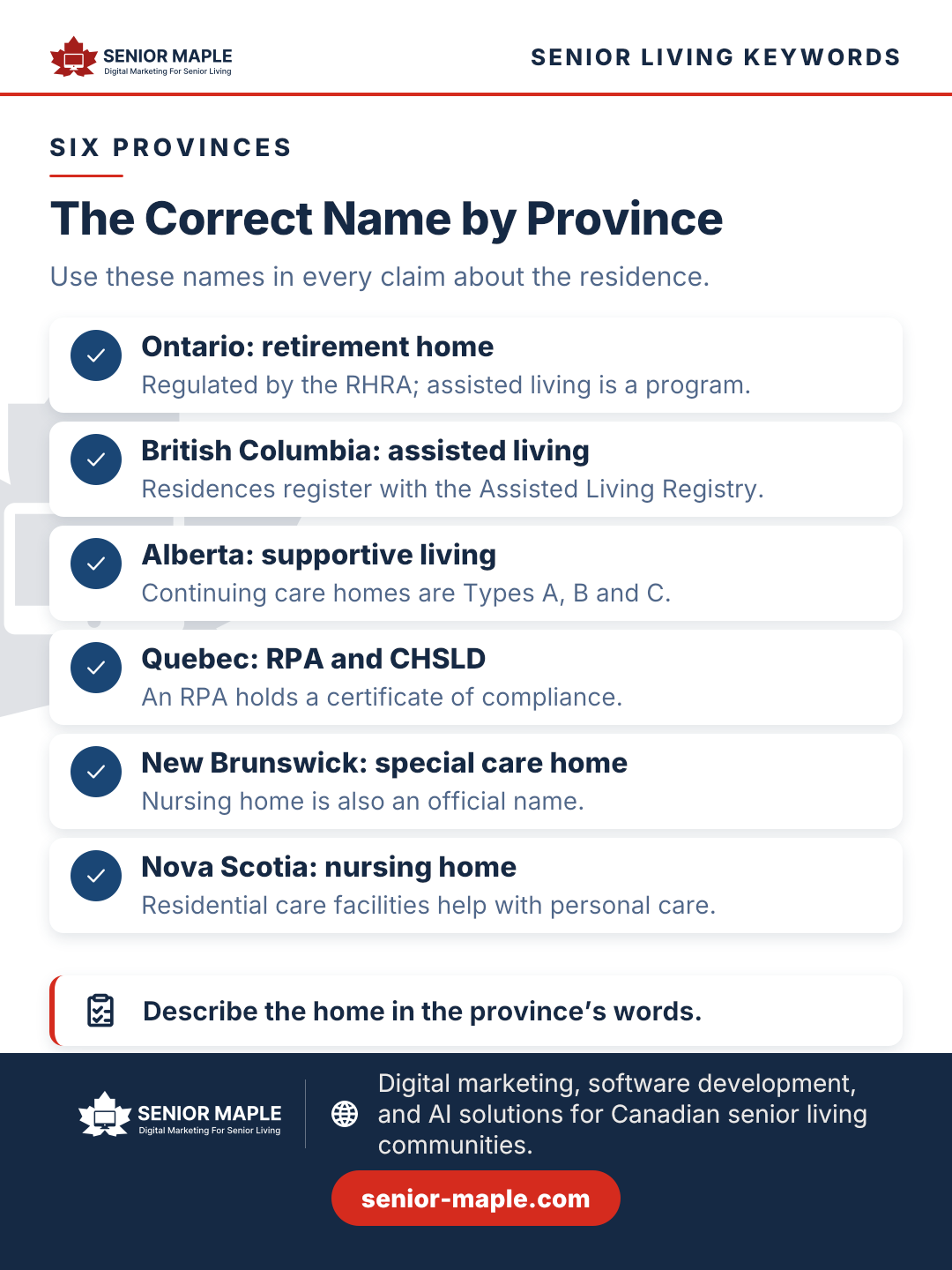
Key Takeaway: Check the licence or registration category for each residence, and use that name in every sentence that describes what the residence is.
How can a care-level page match both vocabularies?
Use the province's name for what the residence is, and answer the family's term where they'll see it. A family that searched "assisted living ottawa" should land on a page that explains what it found.
On an Ontario retirement home's care page, that means a title and heading built on the correct name, such as "Retirement living with care in Ottawa", and an early, plain paragraph: families often search for assisted living; in Ontario, a private residence that offers care services is a retirement home regulated by the RHRA; here is the care it provides and what it costs. The search term appears honestly, and the page never calls the home something its licence doesn't cover.
The same rule runs through the rest of the page. Choose the Google Business Profile category that matches the licence, describe care levels in the province's terms, and keep "nursing home" for New Brunswick and Nova Scotia. A mistake that turns up in Senior Maple Marketing's site reviews is a retirement home described as a nursing home in its own meta description, which can draw inquiries for care the home doesn't provide. When a care page needs more than new copy, website design work can rebuild it around care levels.
Families also put these questions to AI tools in full sentences, such as whether a retirement home is the same as assisted living in Ontario. A page that answers in plain words, with the correct names, gives those tools something accurate to quote; our guide to how AI search is changing discovery covers the rest.
The graphic below pairs four habits to avoid with what to do instead.
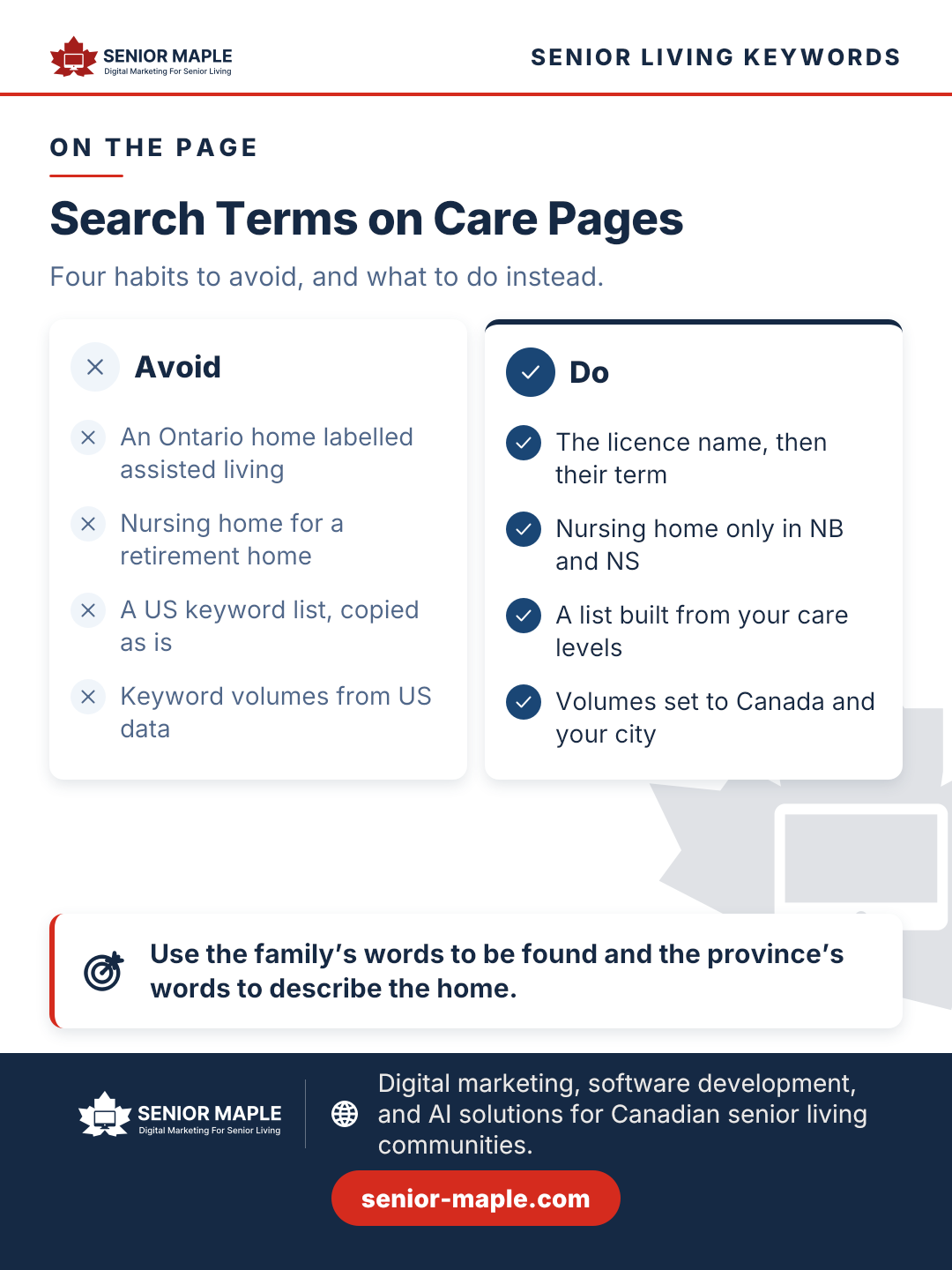
Key Takeaway: Put the province's name in every claim on the page, and answer the family's search term in one plain paragraph near the top.
How do you build a senior living keyword list for a residence?
Start from the licence and the care levels, then add the family's words for each. Five steps cover a single residence:
- List what the residence is. Its provincial category, the care levels it offers and the cities families search from.
- Add the family's words. For each care level: the US terms, the local terms, "near me" and the city names, plus French terms for Quebec residences.
- Check Canadian volumes. Set the keyword tool to Canada, then compare with your own Search Console queries, which show the words people already use to find you.
- Give each page one main term. Group close variants and the city with it, so two pages don't compete for the same search.
- Build ad groups the same way. In Google Ads, group keywords by care level and city, and add negative keywords for job searches and for care the residence doesn't offer.
Repeat the volume check once a year; families' words shift, and a new building nearby can change which city names matter. Our guide to the senior living marketing plan shows where search sits in the channel mix.
Key Takeaway: Build the list from the licence and care levels outward, and give every care-level page one main term and its city.
Frequently Asked Questions
Which senior living keywords do Canadians search for?
Near-me searches lead. In Ahrefs' Canadian data, "retirement home near me" draws about 2,400 searches a month, "long term care near me" 1,300, "assisted living near me" 900 and "nursing home near me" 700. City searches split by region: in Calgary and Edmonton, "assisted living" far outdraws Alberta's own term, supportive living, while in Ottawa "retirement homes" leads. Check volumes for each city you serve.
Is assisted living the same as a retirement home in Ontario?
No. In Ontario, private residences that offer care services are retirement homes, regulated by the Retirement Homes Regulatory Authority, and residents pay the full cost. "Assisted living" is also the name of a program that Ontario Health atHome care coordinators help eligible people arrange in their own home setting. Families still search "assisted living", so explain the difference on the page rather than adopting the label.
Can we use "nursing home" in our keywords?
In ad keywords and research, yes, because families search it: "nursing home near me" draws about 700 searches a month in Canada. In page copy, use it only where it's an official name, as in New Brunswick and Nova Scotia. Elsewhere, explain that the province calls 24-hour nursing care long-term care, and never use "nursing home" to describe a retirement home.
Should our keyword research use US data?
No. Set the keyword tool to Canada, and to your province or city where it allows. US data reflects American searches, so it favours American terms and says little about Canadian ones such as "retirement home" and "CHSLD". Then compare the tool's estimates with your own Search Console queries, which show the words people already use to find your residence, including searches too small for a tool to report.
How many keywords should one care-level page target?
One main term, with its close variants and the city. A retirement home's care page in Ottawa might target "retirement homes ottawa" and answer "assisted living ottawa" in an early paragraph. Giving each page one main term keeps your own pages from competing with each other, and it makes clear which page should rank for which search.
How Senior Maple Marketing approaches senior living keywords
We start from the licence. For each residence, we record its provincial category, the care levels it offers and the cities its families search from, because every keyword decision rests on what the residence is.
Next, we pull Canadian search volumes for both vocabularies, the family's terms and the province's, and set them beside the residence's own Search Console queries. Each care-level page gets one main term and its city, and the copy uses the correct name in every claim while answering the family's term near the top. For paid search, we build ad groups by care level and city, with negative keywords for job searches and care the residence doesn't offer.
Our Digital Marketing team writes the pages and runs the campaigns, and we review the list once a year or when a new building opens nearby.
We advise against three things: copying a US keyword list, describing a residence by a category it isn't licensed or registered for, and choosing keywords by volume alone.
Conclusion: Start with the licence, then match the search
Check each residence's licence or registration category, list the family's words for each care level, and pull Canadian volumes for the cities you serve. Then fix the pages that misname the setting before you add new ones.
If your keyword list came from a US template, Senior Maple Marketing's SEO and AI search optimization team can rebuild it around your provinces and care levels. Send us your current list and your main care-level page, and we'll mark the searches the page misses.
Sources
- Government of Ontario, "Find a retirement home", updated February 10, 2026.
- Ontario Health atHome, "Assisted Living".
- Government of British Columbia, "Assisted Living", updated January 1, 2026.
- Government of Alberta, "Continuing care: Overview", July 24, 2026.
- Gouvernement du Québec, "Private seniors' residences", updated August 2, 2024.
- Gouvernement du Québec, "Visites d'évaluation de la qualité des milieux de vie", updated May 21, 2026.
- Government of New Brunswick, "New Brunswick Adult Residential Facilities", September 2024.
- Government of New Brunswick, "First licensed long-term care home operated by First Nation planned for Elsipogtog region", October 29, 2026.
- Government of Nova Scotia, "Long Term Care".
Stay Ahead - Subscribe Now!
You may also be interested