Senior Living Pricing in Canada: Should You Publish It?

Share the page:
Senior living pricing belongs on your website as a starting monthly price for each suite type, with what it includes, what costs extra and the date it was set. Families price you before they call, and in Ontario a licensed retirement home's itemized price list must already go to anyone who asks for it. Publishing comes with one hard rule: under the Competition Act, an advertised price that leaves out mandatory fees is drip pricing. The Competition Tribunal ordered Cineplex to pay more than $38.9 million over a mandatory $1.50 online booking fee, and the Federal Court of Appeal upheld the decision in January 2026. This guide is for owners, executive directors and marketing leads of Canadian private-pay residences.
Introduction: Families have priced you before they call
A residence website can answer every question except the first one families ask. In the website reviews Senior Maple Marketing runs for operators, the pricing page is often a single line, "Contact us for pricing," above a form. The family fills it in, the sales counsellor calls back, and the conversation opens with the number the page wouldn't give.
The case against publishing is familiar: a number scares families off, competitors copy it, and care costs depend on an assessment. Each objection has an answer, and in Ontario the law has already settled part of the question.
Should a residence publish its prices online?
Yes: a starting monthly price for each suite type, with what it includes, what costs extra and the date it was set. That answers the first question without pretending that care costs are fixed before an assessment.
Families are comparing anyway. Ontario's guide to choosing a retirement home tells families to ask what services cost extra and how much, and says the home's itemized list of accommodation and care prices should be readily available to anyone who requests it, in print or electronically. A family that can't find a number on your site will find one somewhere else, or call the residence that showed it.
The objections hold up less well than they sound. A price does turn away families who can't afford the residence, but those calls seldom end in a move-in and they take the counsellor's time. In Ontario, competitors can already get your list by asking for it. And the assessment problem goes away once you separate the two: publish the accommodation price, and give care packages a starting price that depends on the assessment.
If the sales team isn't convinced, test it. Publish a starting price on one residence's pages for a quarter and compare inquiries, the inquiry-to-tour rate and the tour-to-move-in rate with the quarter before and with a similar residence that didn't change. Your CRM should already hold those numbers; if it can't produce them, fix that first with CRM integration. Our guide to senior living occupancy explains how to read the rates.
The graphic below compares the four ways residences show a price.
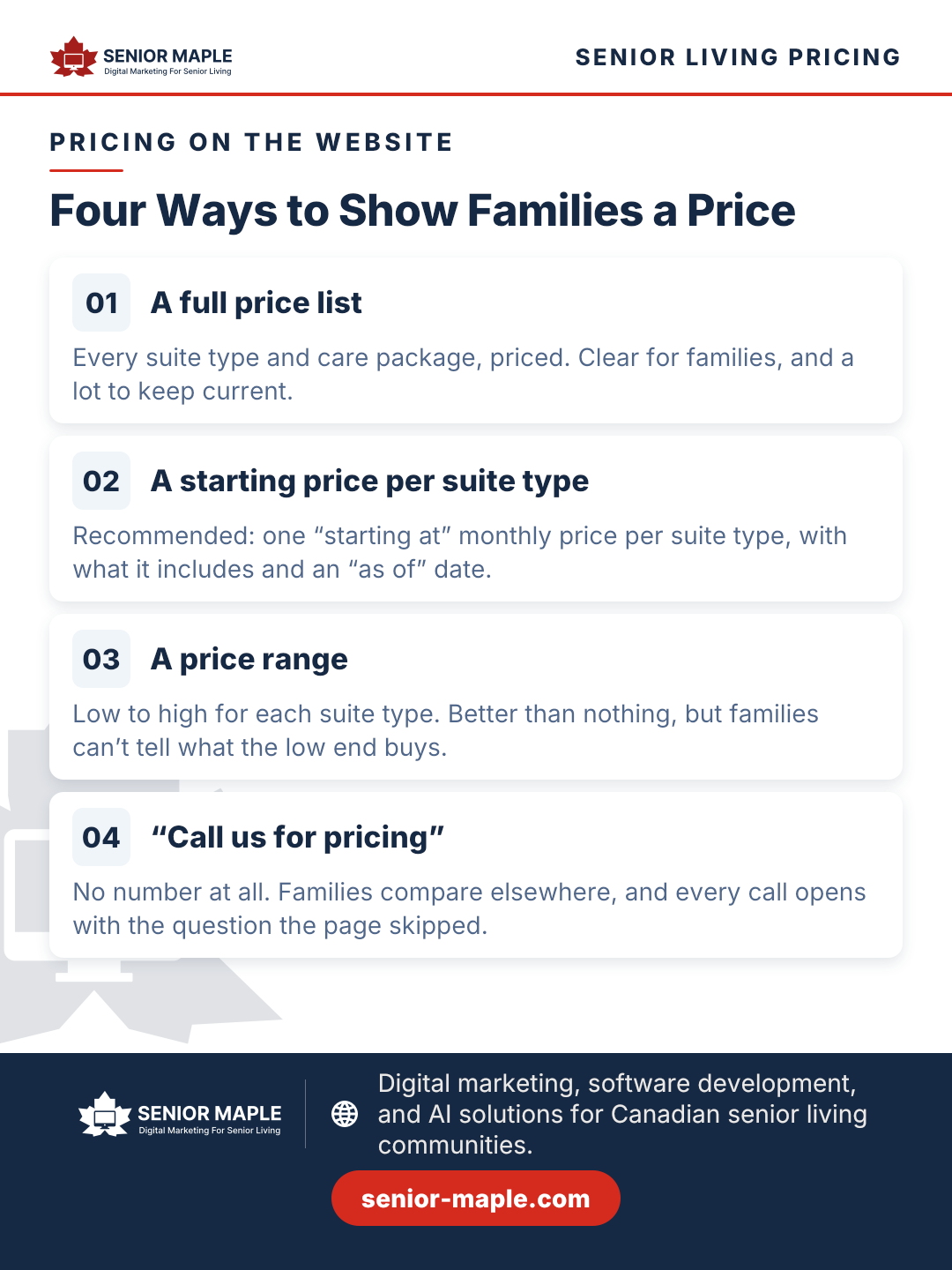
Key Takeaway: Publish a starting monthly price for each suite type with an "as of" date, then compare inquiry-to-tour and tour-to-move-in rates over the next quarter.
What does the Competition Act say about a published price?
It has to be a price a family can actually pay. The Competition Bureau describes drip pricing as offering a price that's unattainable because consumers must also pay additional charges, and amendments to the Competition Act in force since June 2022 explicitly recognize it as a harmful practice. Only fixed charges imposed by government, such as sales tax, are exempt, and the Bureau warns that variable fees can raise concerns too.
The Cineplex case shows what's at stake. In September 2024, the Competition Tribunal ordered Cineplex to pay more than $38.9 million for adding a mandatory $1.50 online booking fee to its ticket prices, matching what the fee collected between June 2022 and December 2023. The Federal Court of Appeal upheld the decision in January 2026.
For a residence, the risk sits in mandatory charges that live in the agreement rather than on the page: a one-time community or move-in fee, a meal plan every resident must buy, or a basic care package that comes with the suite. The one-time fee is the usual gap, and in the website-to-agreement comparisons Senior Maple Marketing runs, it's often missing from the page. If every resident must pay it, put it in the advertised price or right beside it with the same weight, and have counsel review the wording. Optional care packages can stay separate, as long as the page says they're priced by assessment.
Key Takeaway: List every charge a new resident must pay, and make sure each mandatory one appears in the advertised price or right beside it before the page goes live.
What do provincial rules already make public?
In Ontario, the price list is effectively public already. Under the Retirement Homes Act, 2010, a licensed retirement home's information package must include an itemized list of its types of accommodation and care services and their prices, given before residency begins, and that list must be available in print or electronic form to anyone who requests it. The Residents' Bill of Rights adds the right to know what care services cost and to be told about increases in advance.
Tenancy law adds a second disclosure. Under Ontario's Residential Tenancies Act, 2006, the landlord of a "care home" (the Act's term for a rental with care services) must give a new tenant a care home information package with the charges for each type of accommodation and each package of care services and meals before the tenancy agreement is signed. Increases to rent or to care and meal charges need at least 90 days' written notice, and rent can go up only once every 12 months.
So in Ontario, the website price is the same list made easier to find, and it should match that list to the dollar. Our senior living marketing plan guide makes the same point about ads.
Elsewhere, governments publish the number for some settings, and private-pay residences sit next to those published figures.
A family weighing your residence against a long-term care home or a subsidized suite already has a number for the other option. A blank on your side of the comparison doesn't read as discretion. It reads as expensive.
Key Takeaway: In Ontario, publish the same itemized prices you must already give anyone who asks, and update the page the day the list changes.
How should you present a price families can trust?
Put six things beside the number: the suite type and size, a starting monthly price a family can actually get, what that price includes, what costs extra, every mandatory fee, and an "as of" date. Then make sure the same number appears everywhere a family might meet it.
That last part breaks more often than the page itself. The website says one thing, a directory listing says another from two years ago, a paid search ad says a third, and the counsellor quotes a fourth on the phone. Keep one approved price list, owned by one person, and update every channel from it when prices change. If you run a chat assistant on the site, it should answer price questions from that same list and hand care questions to a person, which AI chatbots can do when they're built on the approved list rather than on last year's pages.
Put the price block on each suite and care page, next to the floor plan. Care-level pages that pair a price range with a short form are central to our senior living lead generation guide, and getting that layout right is website design work as much as copy. On the phone, answer the price question in the first minute, then ask about care needs. A counsellor who dodges the number loses the trust the page just earned.
The checklist below sets out what belongs next to every published price.
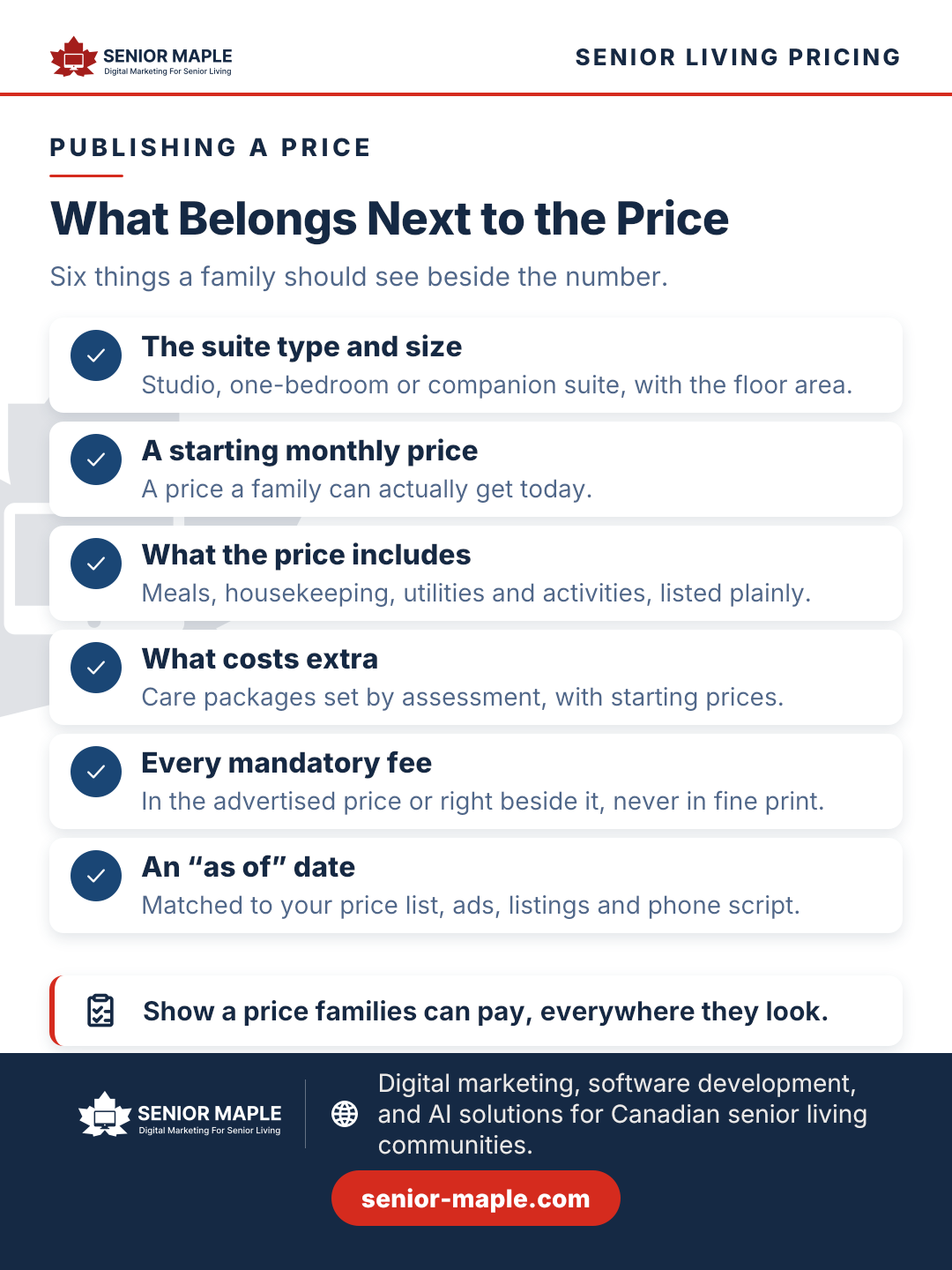
Key Takeaway: Keep one approved price list, update the website, ads, directory listings, chat and phone script from it on the same day, and show the "as of" date on the page.
Frequently Asked Questions
Should senior living communities publish their prices online?
In most cases, yes: a starting monthly price for each suite type, with what it includes, what costs extra and the date it was set. Families compare prices before they call, and in Ontario a licensed retirement home's itemized price list must already be available to anyone who asks. Test the change on one residence and compare inquiry-to-tour and tour-to-move-in rates over a quarter.
Is "starting at" pricing allowed under Canada's drip pricing rules?
A "starting at" price is fine if a family can actually get it. Under the Competition Act, an advertised price that's unattainable because of mandatory added charges can be drip pricing, and only government-imposed charges such as sales tax are exempt. Include mandatory fees in the price or show them beside it with the same weight, describe optional care packages as priced by assessment, and have counsel review the wording.
Do Ontario retirement homes have to share their prices?
Yes. Under the Retirement Homes Act, 2010, a licensed retirement home's information package must include an itemized list of its accommodation and care services and their prices, and that list must be available in print or electronic form to anyone who requests it. Residents also have the right to know what care services cost and to be told about increases in advance.
How much notice does an Ontario retirement home need to raise prices?
At least 90 days' written notice for increases to rent or to charges for care services and meals, under Ontario's tenancy rules for care homes, and rent can go up only once every 12 months. Date the published price on your website so families know which list they're reading, and update the page the day the list changes.
Will publishing prices reduce senior living inquiries?
It may reduce inquiries from families who can't afford the residence, which saves the sales team time on calls that seldom end in a move-in. What matters is the inquiry-to-tour and tour-to-move-in rates that follow. Publish on one residence first, compare a quarter of results with the quarter before and with a similar residence, and decide from those numbers.
How Senior Maple Marketing approaches senior living pricing on the web
We start by reading the price the way a family meets it: the website, the directory listings, the paid search ads, the chat, and a call to each residence. We set that against the itemized price list and the agreement, so every mandatory charge is visible before anything is published.
Next comes one approved price list, owned by one person on the operator's side, and a price block on each suite and care page: starting monthly price, inclusions, extras, mandatory fees and an "as of" date. Our Digital Marketing team builds the pages and updates ads and listings from the same list, and our AI Solutions team connects any chat assistant to it.
We run the change on one residence first and report inquiries, inquiry-to-tour and tour-to-move-in rates against the previous quarter, so the decision to roll it out rests on the operator's own numbers.
We advise against "call for pricing" with no number at all, teaser prices that no available suite matches, prices that leave out a mandatory fee, and price lists that differ between the website, the ads and the phone.
Conclusion: Put one honest number on every suite page
This month, pull your itemized price list and your agreement, list every mandatory charge, and write a starting price for each suite type, with its inclusions and an "as of" date. Put it on one residence's pages, line up the ads, listings and phone script behind it, and read the results after a quarter.
If your suite pages can't hold a price block cleanly, Senior Maple Marketing's website design team can rebuild them around one. Send us a residence page and its current price list, and we'll show you where a family loses the thread.
Sources
- Competition Bureau Canada, "Drip pricing", modified August 24, 2026.
- Competition Bureau Canada, "Competition Bureau wins deceptive marketing case against Cineplex", September 23, 2024.
- Supreme Court of Canada, case 42267, Cineplex Inc. v. Commissioner of Competition (docket listing the Federal Court of Appeal decision, 2026 FCA 10).
- Government of Ontario, Retirement Homes Act, 2010, S.O. 2010, c. 11, sections 51, 54 and 55.
- Government of Ontario, "Find a retirement home".
- Retirement Homes Regulatory Authority, "Exploring Licensed Retirement Home Living", May 2026.
- Landlord and Tenant Board, "Rules for Care Homes".
- Government of Ontario, "Long-term care accommodation costs".
- Government of Alberta, "Continuing care accommodation charges", updated June 26, 2026.
- Government of British Columbia, "Assisted Living", updated January 1, 2026.
Stay Ahead - Subscribe Now!
You may also be interested