Memory Care Marketing in Canada: Language, Search and Sales

Share the page:
Memory care marketing in Canada works when every page, ad and phone call describes people living with dementia the way the Alzheimer Society of Canada recommends, uses each province's name for the care, and answers the clinical questions families ask before they visit. The Public Health Agency of Canada counted close to 487,000 people aged 65 and older living with diagnosed dementia between April 2022 and March 2023, and their families search for "dementia care" about as often as "memory care". This guide is for marketing and sales directors at Canadian retirement residences with a memory care neighbourhood: the language, the search terms and the sales conversation.
Introduction: Families judge memory care by its words before its walls
When Senior Maple Marketing reviews memory care pages, three problems come up again and again: wording that describes the disease before the person, care names that don't match the province, and tours where nobody can answer a clinical question. Each one costs trust with a family that's often deciding under pressure.
The sections below take them in turn, then cover where search and ads fit and how the sales team should handle the first call.
What language should memory care marketing use?
Person-centred language: the person first, the condition second, and specific descriptions instead of labels. The Alzheimer Society of Canada publishes a word list for this, and it's a practical standard for every page, ad, brochure and call script.
The table pairs common marketing words with what to write instead.
The last row matters most for marketing. Families want to know the neighbourhood is safe, so say how: a secured garden, doors that open onto it, staff who walk with residents. That tells them more than "secure" or "locked", and it doesn't describe their parent's home as a ward.
Key Takeaway: Check every memory care page, ad and call script against the Alzheimer Society of Canada's word list before it goes live, and replace each label with a specific description.
What do families search for, and what do provinces call memory care?
Families search for both "memory care" and "dementia care", usually with a city name. In Ahrefs' Canadian data, "memory care near me" draws about 350 searches a month and "dementia care near me" about 150, but city searches often lean the other way: "dementia care calgary" draws about 200 against 100 for "memory care calgary", and Vancouver and Ottawa follow the same pattern. Use "memory care" as the program's name and "dementia care" in the plain description, so the page matches both. Our guide to senior living keywords in Canada covers the wider search vocabulary.
What the province calls the care is a separate question:
- Ontario. "Memory care" is a marketing name. In a licensed retirement home, a dementia care program is one of 13 regulated care services, and the Retirement Homes Regulatory Authority's public database shows which care services each home offers. Long-term care homes are reached through Ontario Health atHome.
- Alberta. The publicly funded option is continuing care home Type B, which includes Type B Secure Space.
- New Brunswick. A memory care home is one of the province's official types of adult residential facility.
In other provinces, check the category before using "memory care" for anything more than a program name.
Key Takeaway: Use "memory care" for the program and "dementia care" in the description, and match every claim about the care to what the province's records show.
What should a memory care page tell families?
What the care is, who provides it, what a day looks like, what it costs and what happens when needs change. Families read the page to decide whether a visit is worth it, so the answers belong there, not only on the tour.
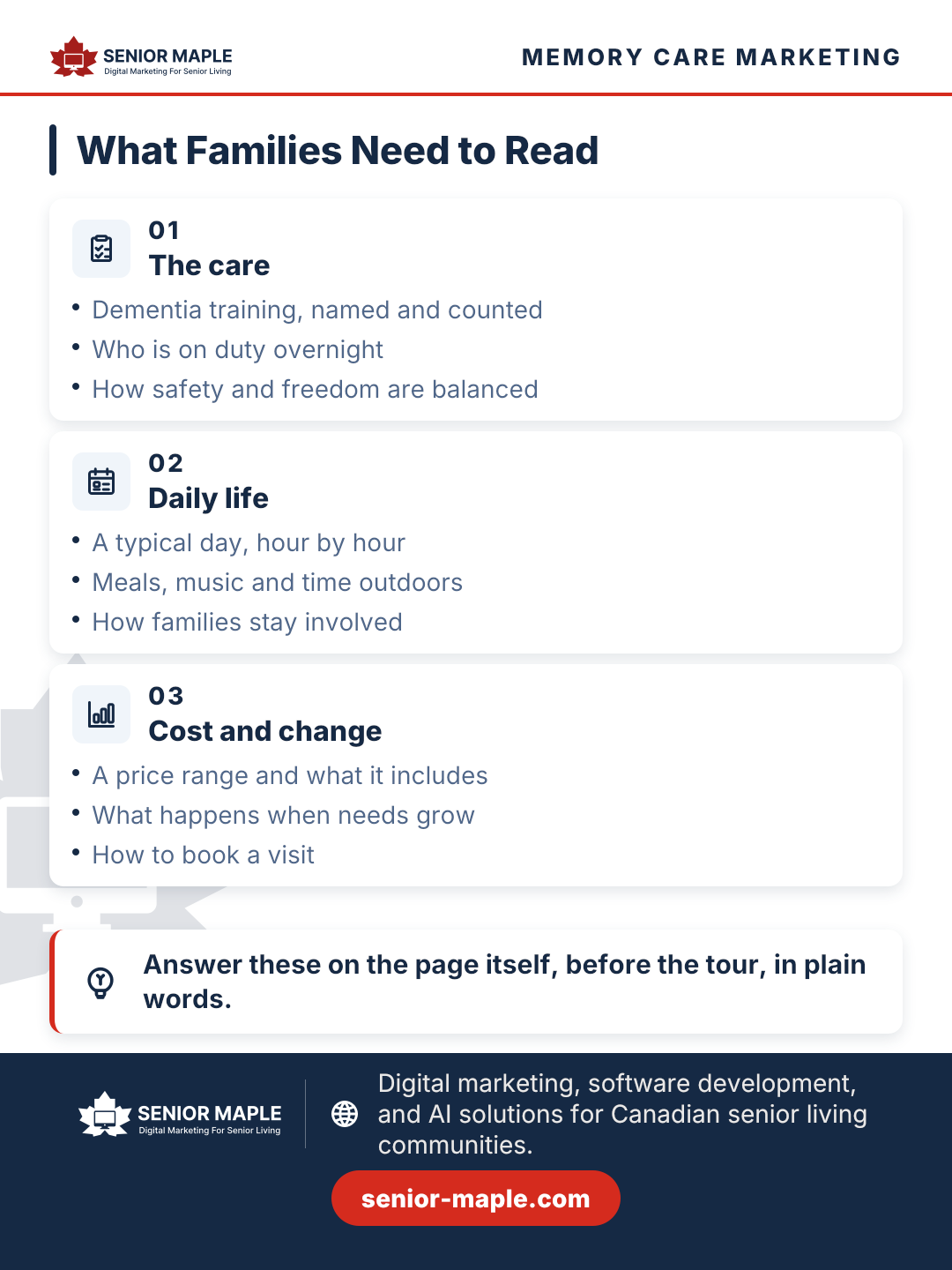
- The care. Name the dementia training staff have completed and how many have completed it, say who is on duty overnight, and explain how the neighbourhood keeps people safe while letting them move freely.
- Daily life. Walk through a typical day: meals, music, time outdoors, quiet hours. Explain how families stay involved and how they hear about changes.
- Cost and change. Give a price range and what it includes, and say what happens when care needs grow beyond what the residence offers. In Ontario, licensed retirement homes must give residents a price list for accommodation, care services and extras, so the website can match it.
A gap that turns up in Senior Maple Marketing's page reviews is the night shift: pages describe daytime programs in detail and say nothing about who is on duty at 3 a.m., a question families often raise on tours.
Photos matter as much as words. Use pictures of your own residents and team, with written consent from the resident or the person legally authorized to give it, and show people doing something they enjoy. Photography and video shot in the neighbourhood itself can replace the stock images many memory care pages rely on.
The graphic below groups what a memory care page should answer.
Key Takeaway: Put night staffing, the price range and what happens when needs change on the memory care page itself.
Where do search and ads fit in memory care marketing?
After the words and the page are right. Search and ads send families to that page, so it has to hold up when they arrive.
Build Google Ads ad groups by city with both "memory care" and "dementia care" terms, add negative keywords for job searches, and send every ad to the memory care page rather than the home page. On Facebook and Instagram, the audience is often the adult child; Meta advertising built on real photos and a plain description of the care speaks to them directly. Keep every ad inside what the province's records show the residence offers.
Key Takeaway: Send memory care ads only to the memory care page, with both vocabularies in the keywords and nothing in the ad that goes beyond the care the residence provides.
How should the sales team handle a memory care inquiry?
Slowly enough to learn about the person, and with someone on hand who can answer clinical questions. Many memory care inquiries come after a hard week, and the first call sets the tone.
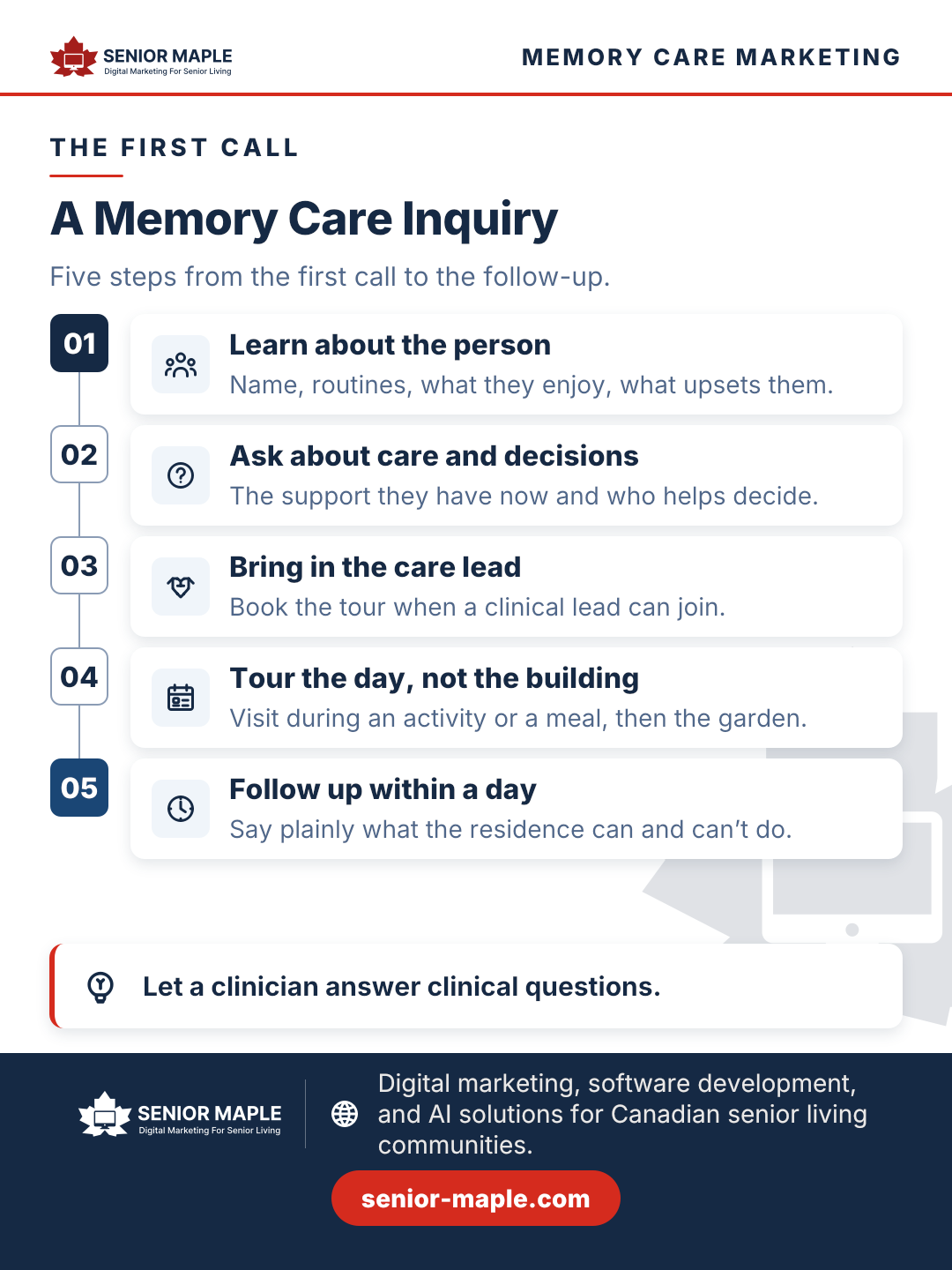
- Learn about the person. Their name, routines, what they enjoy and what upsets them.
- Ask about care and decisions. The support they have now, and who helps make decisions with them.
- Bring in the care lead. Book the tour for a time when the director of care or memory care lead can join.
- Tour the day, not the building. Visit during an activity or a meal, and include time in the garden.
- Follow up within a day. Say plainly what the residence can and can't provide. If needs go beyond it, say so and point the family to the right option; in Ontario, long-term care is arranged through Ontario Health atHome.
Honesty at step five protects everyone: a move that doesn't fit can end in an early move-out, as our guide to senior living occupancy explains.
The graphic below sets out the five steps.
Key Takeaway: Book memory care tours when a clinical lead can join, and follow up within a day with what the residence can and can't provide.
Frequently Asked Questions
What is memory care marketing?
Marketing for a memory care program: the pages, ads, photos and sales conversations that help the family of a person living with dementia judge whether a residence fits. In Canada, it has to follow person-centred language, use each province's name for the care, and answer clinical questions about staffing, safety and cost plainly.
Which words should memory care marketing avoid?
The Alzheimer Society of Canada advises against terms such as "sufferer", "victim", "demented", "senile dementia" and "early onset dementia"; write person living with dementia and young onset dementia instead. It also advises against labels such as "wandering", "sundowning" and "challenging behaviour", and recommends describing the specific behaviour. Words like "locked unit" and "facility" make a memory care neighbourhood sound like a ward.
Is memory care a licensed category in Canada?
Mostly not: it's usually a program name. New Brunswick lists memory care homes among its official types of adult residential facility, and Alberta's publicly funded option is continuing care home Type B, including Type B Secure Space. In Ontario, a dementia care program is one of the regulated care services a licensed retirement home can offer, and the public database shows which homes offer it.
Can we use photos of residents living with dementia in marketing?
Yes, with written consent from the resident or the person legally authorized to give it, and only images that show the person as they would want to be seen, doing something they enjoy. Avoid images of distress, keep a record of each consent, and remove photos promptly when consent is withdrawn. Have counsel confirm which privacy law applies to your residence.
Should memory care pages show prices?
A range, with what it includes: the base rate, the care package and any extra charge for the dementia care program. Families compare residences on price, and a page without one can send them to a competitor's page or a referral service first. In Ontario, licensed retirement homes must give residents a price list for accommodation, care services and extras, so the website can match it.
How Senior Maple Marketing approaches memory care marketing
We start with the words. Every memory care page, ad, brochure and call script is checked against the Alzheimer Society of Canada's person-centred language guidance and the province's names for the care, and labels are replaced with specific descriptions.
Next, we rebuild the memory care page around the questions families ask: training and night staffing, a typical day, how the neighbourhood keeps people safe while letting them move freely, price, and what happens when needs change. Photos come from the residence, with consent. Our Content Marketing team writes the page and the call scripts, and our Digital Marketing team runs search and paid campaigns to it by city.
Then we work with the sales team on the first call and the tour, so a care lead is there for the clinical questions.
We advise against three things: stock photos of distress, "locked unit" language, and ads that promise more care than the residence provides.
Conclusion: Fix the words before you buy the clicks
Read your memory care page this week against the word list, add the answers on night staffing, price and changing needs, and brief the sales team on the five-step call. Then point search and ads at the page.
If you'd like a second reader, Senior Maple Marketing's content marketing team reviews memory care pages and call scripts. Send us the page link, and we'll mark the words and the missing answers.
Sources
- Public Health Agency of Canada, "Dementia: Overview", modified January 20, 2025.
- Alzheimer Society of Canada, "Using person-centred language".
- Retirement Homes Regulatory Authority, "Exploring Licensed Retirement Home Living", May 14, 2026.
- Government of Ontario, "Find a retirement home", updated February 10, 2026.
- Alberta Health Services, "Continuing Care Home Type B & Type B Secure Space".
- Government of New Brunswick, "New Brunswick Adult Residential Facilities", September 2024.
Stay Ahead - Subscribe Now!
You may also be interested